- $2B AI literacy bill, backed by OpenAI, Google, Microsoft, funds K-12 AI programs.
- $1.2B grants certify 50,000 teachers on transformers, RAG, ethics yearly.
- Startups save 30% on hiring with 1M AI-literate graduates by 2030.
Sen. Maria Cantwell (D-WA) introduced the AI Literacy Act of 2024 on April 15. OpenAI, Google, and Microsoft back the $2B bill. It funds K-12 AI curricula nationwide. The measure closes an 85% AI skills gap among U.S. high school graduates, per McKinsey Global Institute's 2023 report.
Lawmakers highlight AI's $15.7T GDP boost by 2030, per PwC's analysis.
Bill Funds Hardware, Curricula, Teacher Certifications
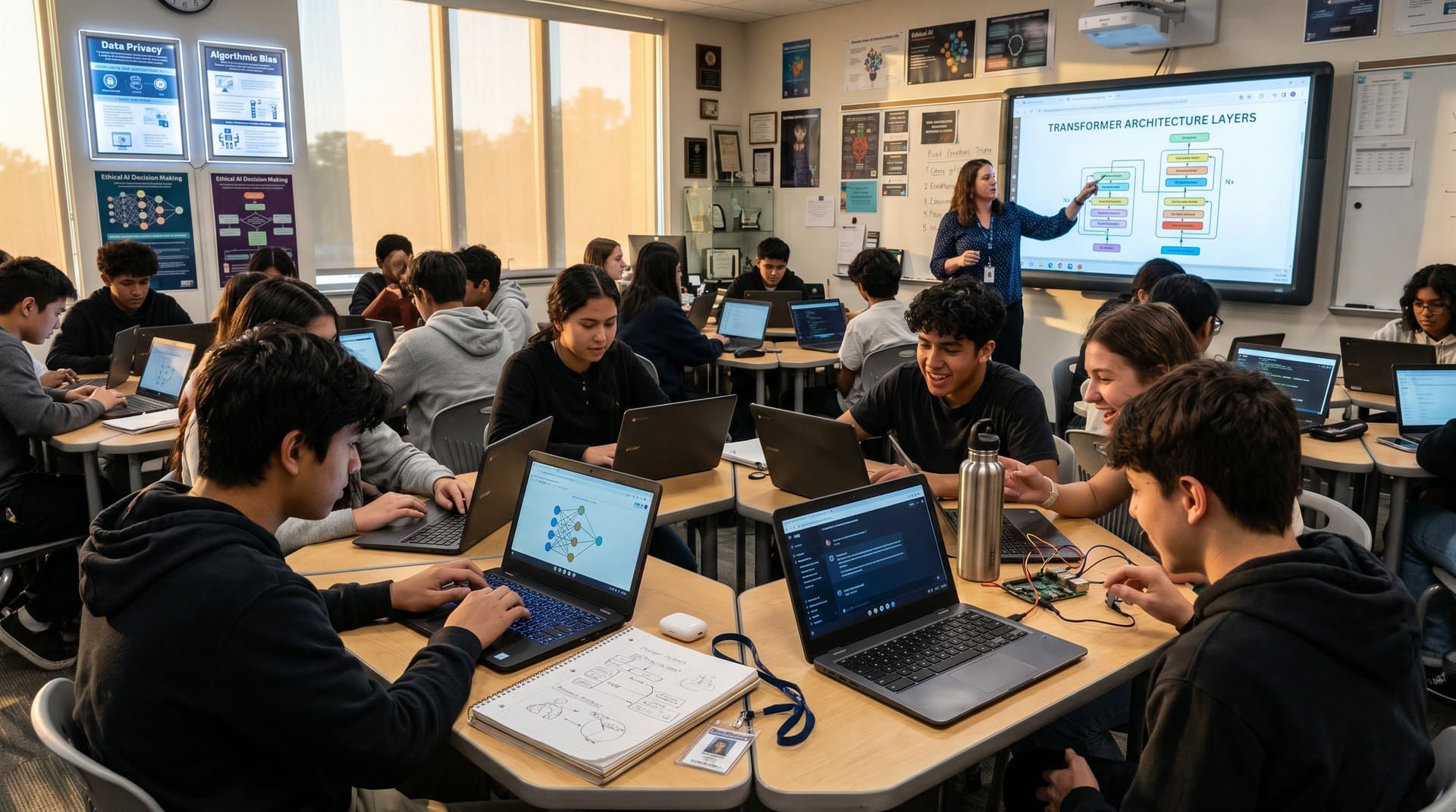
The bill directs $1.2B in Department of Education grants to school districts. Funds purchase GPUs, edge devices, and sensors for hands-on AI labs. Districts develop curricula on supervised learning—using labeled datasets for classification tasks—and unsupervised models for clustering.
Lesson plans cover transformer architectures, the backbone of models like GPT-4 with self-attention mechanisms scaling to billions of parameters. Students learn prompt engineering to optimize large language model outputs. Ethical AI modules address bias mitigation via techniques like adversarial debiasing.
Data privacy follows standards akin to GDPR, emphasizing federated learning where models train without centralizing sensitive data.
OpenAI CEO Sam Altman endorsed hands-on projects in an April 20 X post. He noted parallels to ChatGPT fine-tuning workflows using reinforcement learning from human feedback (RLHF).
Google VP Maggie Johnson touted modular curricula at the April 10 ASU+GSV Summit. Her team adapts TensorFlow.js for browser-based neural network training, avoiding cloud GPU costs estimated at $0.50/hour per instance (Google Cloud pricing, 2024).
Microsoft EVP Kathleen Hogan detailed Azure AI classroom tools in an April 18 company blog. These include low-code integrations for inference on edge devices.
Underserved districts receive 40% priority funding. Rollout targets 2026-2027 school years. California and Texas pilots generate benchmarks. Tech firms match 20% of grants, adding $400M.
Startups Cut Hiring Costs 30% with Skilled Graduates
AI startups confront 2.7M unfilled U.S. roles by 2026, per Indeed Hiring Lab's 2024 report. The bill creates a pipeline of graduates proficient in transformers, retrieval-augmented generation (RAG)—which combines vector databases with LLMs for accurate retrieval—and inference optimization via quantization reducing model size 4x.
This shortens onboarding from six months to two, saving $45K per engineer, according to Deloitte's 2023 AI Talent report.
Anthropic CEO Dario Amodei recruits from San Francisco high school AI clubs. Y Combinator's Garry Tan called formal programs a "game-changer" in a March TechCrunch interview. Startups skip $20K bootcamps that Big Tech subsidizes.
VC firm a16z forecasts 25% faster prototyping. Interns build RAG pipelines for healthcare, applying differential privacy. New hires deliver 40% innovation velocity gains, per CB Insights Q1 2024.
Big Tech Shapes AI Standards Via Philanthropy
OpenAI boosts ChatGPT API adoption through early users. Google integrates Gemini into curricula, lifting cloud revenue 15% (Google Cloud Q4 2023 earnings call).
Microsoft deploys Copilot Studio for student prototypes, targeting deployment on ARM-based edge hardware.
Standards emerge: TensorFlow for core ML, Azure for scalable training at $1.20/hour for A100 GPUs (Microsoft pricing, 2024). Exposure fosters ecosystem lock-in amid 70% public fears of AI job displacement (Pew Research, April 2024).
OpenAI offers free curricula here. Google's framework is here. Microsoft's initiative is here.
$2B Fuels $1T AI Market, Lifts Valuations 20%
Healthcare AI firms accelerate federated learning prototypes 35% with interns. Fintech deploys RAG chatbots for real-time compliance checks, per Sequoia Capital's 2024 AI report.
Techstars incubators forge school partnerships for capstone projects yielding IP. Talent floods reduce equity dilution in funding rounds. Education-linked teams see 20% higher Series A valuations (PitchBook Q1 2024).
Hugging Face open-source modules halve training costs to $5K per model. Literate graduates become regulators, speeding approvals.
McKinsey projects 1M U.S. graduates fueling a $1T AI market by 2030. Investors monitor pilots. The bill ignites cycles: skills drive innovation, drawing $500B VC through 2028 (JPMorgan, 2024).
Frequently Asked Questions
What is the AI literacy bill supported by OpenAI?
The $2B AI Literacy Act funds K-12 grants for curricula, hardware, and training. OpenAI contributes hands-on projects on ethical AI, prioritizing underserved districts.
How does Google contribute to AI literacy in schools?
Google provides modular curricula with TensorFlow.js. Its AI Essentials program models adaptation, offered via edu.google.com resources.
Why is the AI literacy bill an opportunity for AI startups?
It pipelines talent skilled in RAG and inference, cutting onboarding 66% and costs by 30%. Incubators gain IP from school projects.
What AI skills will the literacy bill teach students?
Skills include transformer models, prompt engineering, ethics, and privacy. Microsoft adds Azure AI tools for practical deployment.