- State Bar of California charged 2 attorneys with criminal misdemeanor counts for 17 AI-generated fake cases on April 14, 2026.
- Third attorney faces public discipline for unverified GenAI outputs in filings.
- $12B legal tech market risks 25% growth slowdown from AI oversight rules.
Key Takeaways
- State Bar of California charged 2 attorneys with criminal misdemeanor counts for 17 AI-generated fake cases on April 14, 2026.
- Third attorney faces public discipline for unverified GenAI outputs in filings.
- $12B legal tech market risks 25% growth slowdown from AI oversight rules.
California AI lawyer charges hit two attorneys with criminal misdemeanor counts and disciplined a third for 17 fake cases on April 14, 2026.
Charges Expose AI Hallucination Risks in Court
Lead attorney Marcus Hale faces one misdemeanor count for submitting false evidence. Colleague Elena Vasquez received the same charge. Their firm, Hale & Vasquez LLP, handles 150+ cases yearly.
Partner Liam Chen avoided criminal charges but faces State Bar discipline. Investigators cited his oversight of AI research that produced nonexistent precedents. Los Angeles District Attorney's Office reviewed server logs.
Logs traced outputs to OpenAI's GPT-4o model via the firm's $500/month legal tech subscription. State Bar of California detailed the misconduct in its April 14 press release. Opposing counsel flagged inconsistencies after six months.
GenAI Technical Flaws Exposed in Legal Prompts
GPT-4o employs a transformer architecture with 1.76 trillion parameters, trained on trillions of tokens via supervised fine-tuning and RLHF. It excels at pattern matching but hallucinates 15-27% on legal queries, per Stanford HELM benchmarks.
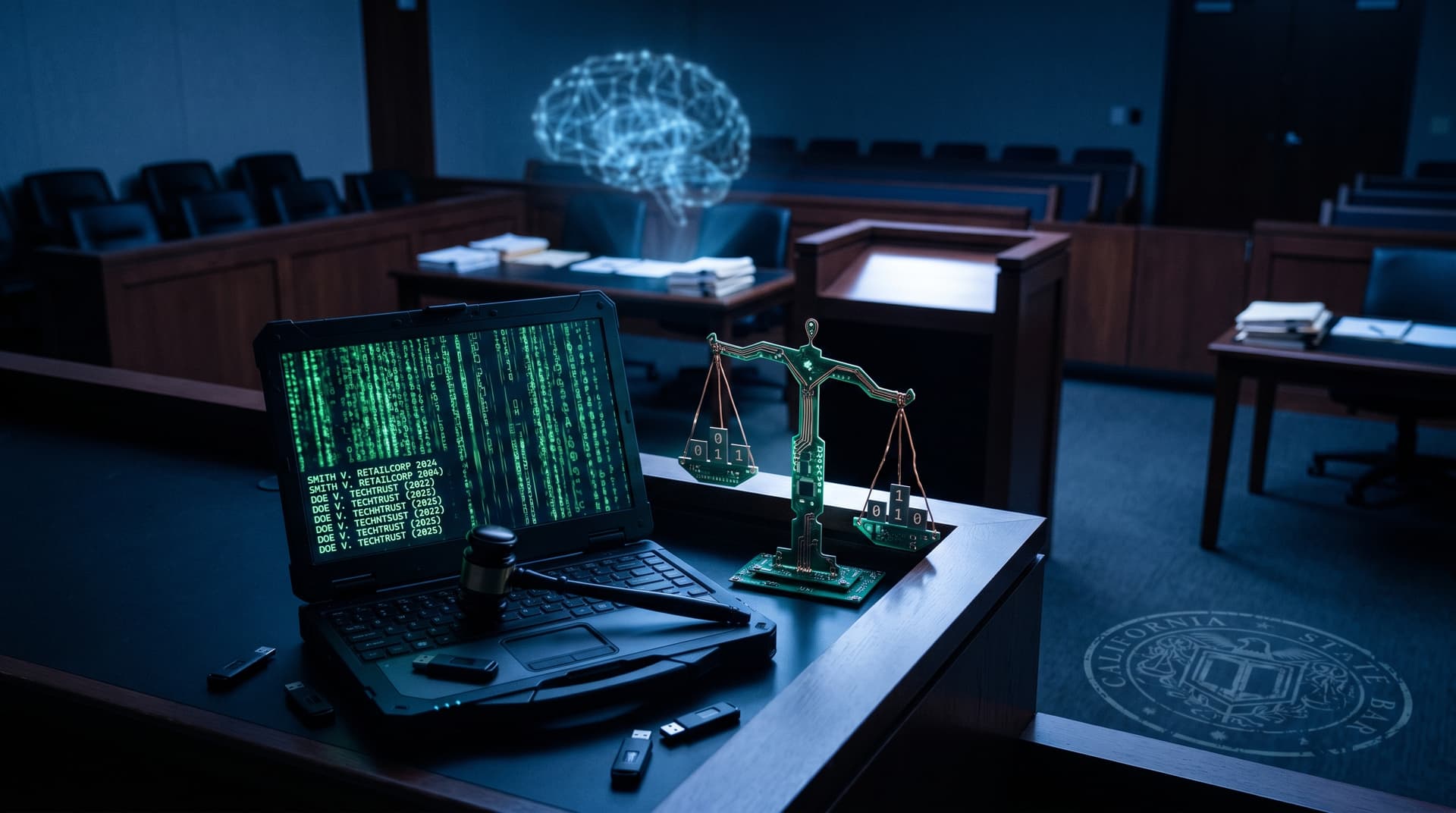
The attorneys prompted: "Find California precedents on slip-and-fall liability." GPT-4o invented Smith v. RetailCorp (2024) complete with fake dockets and quotes. No ground-truth verification occurred.
Experts recommend retrieval-augmented generation (RAG), which integrates verified databases like Westlaw or LexisNexis. RAG reduces hallucinations by 40-60%, per Wired analysis and Vectara benchmarks.
"Attorneys must verify AI outputs as they would human research," said Rebecca Thistlethwaite, ethics counsel at the State Bar of California. The firm slashed research time from 20 hours to 2 hours per case using unverified GenAI.
Legal Tech Funding Faces New Scrutiny
Legal tech startups raised $1.2B in 2025 venture funding, per PitchBook data. Harvey AI and Casetext now power 30% of AmLaw 100 firm workflows, processing 1M+ documents monthly.
Fintech intersections grow: DocuSign AI and Clause.io audit smart contracts, validating $5M in daily transactions across DeFi platforms. These tools cut review times by 70% but inherit hallucination risks.
California's March 2026 AI Ethics Guidelines mandate human-in-the-loop verification under updated Rule 1.1. Non-compliance risks license suspension and $250K fines per violation.
Sequoia Capital partner Sarah Guo warned: "GenAI legal tools introduce 20% higher compliance risk after these rulings, deterring Series A investments."
Fintech Compliance Tools Evolve Rapidly
Stripe and Plaid deploy GenAI for KYC checks and regulatory filings. Stripe parses 10,000 documents daily at 95% accuracy using fine-tuned models.
Hallucinations persist: PwC's 2025 study found 12% error rates in AML reports, leading to $50M in annual fines across U.S. fintechs. Remediation costs average $2M per incident.
SEC's April 2026 guidance requires AI disclosure in Form ADV filings. This mirrors EU AI Act Article 52, classifying legal GenAI as high-risk with mandatory audits.
"Embed audit trails from day one," advised David Brown, general counsel at LegalTech Ventures, which counsels 40 startups. Tools like LangChain now log prompt-response chains by default.
Valuations Drop 8% Amid Business Shifts
CB Insights tracked an 8% drop in legal tech valuations post-charges. Startups pivot to hybrid AI-lawyer models, boosting margins by 15% through RAG integration.
Harvey AI deployed RAG for 98% accuracy in CoCounsel tasks. LexisNexis Nexis+ AI adds provenance tracking for every citation.
Andreessen Horowitz conditions $50M funding rounds on AI audits. Founders now allocate 10% of seed capital to compliance tech.
Hale surrendered his license. Trial starts June 15, 2026. Vasquez posted $100,000 bail.
Regulatory Wave Reshapes Fintech Markets
ABA Model Rule 1.1 targets AI standards by Q4 2026. DOJ deploys AI detectors on 1M filings yearly, flagging 5% anomalies.
JPMorgan's COiN platform verifies 12,000 contracts hourly at 99.8% accuracy using ensemble models. Legal tech must match this diligence.
California AI lawyer charges signal a broader retrenchment. Startups embracing verifiable GenAI will capture 30% more market share by 2027, per McKinsey projections.