
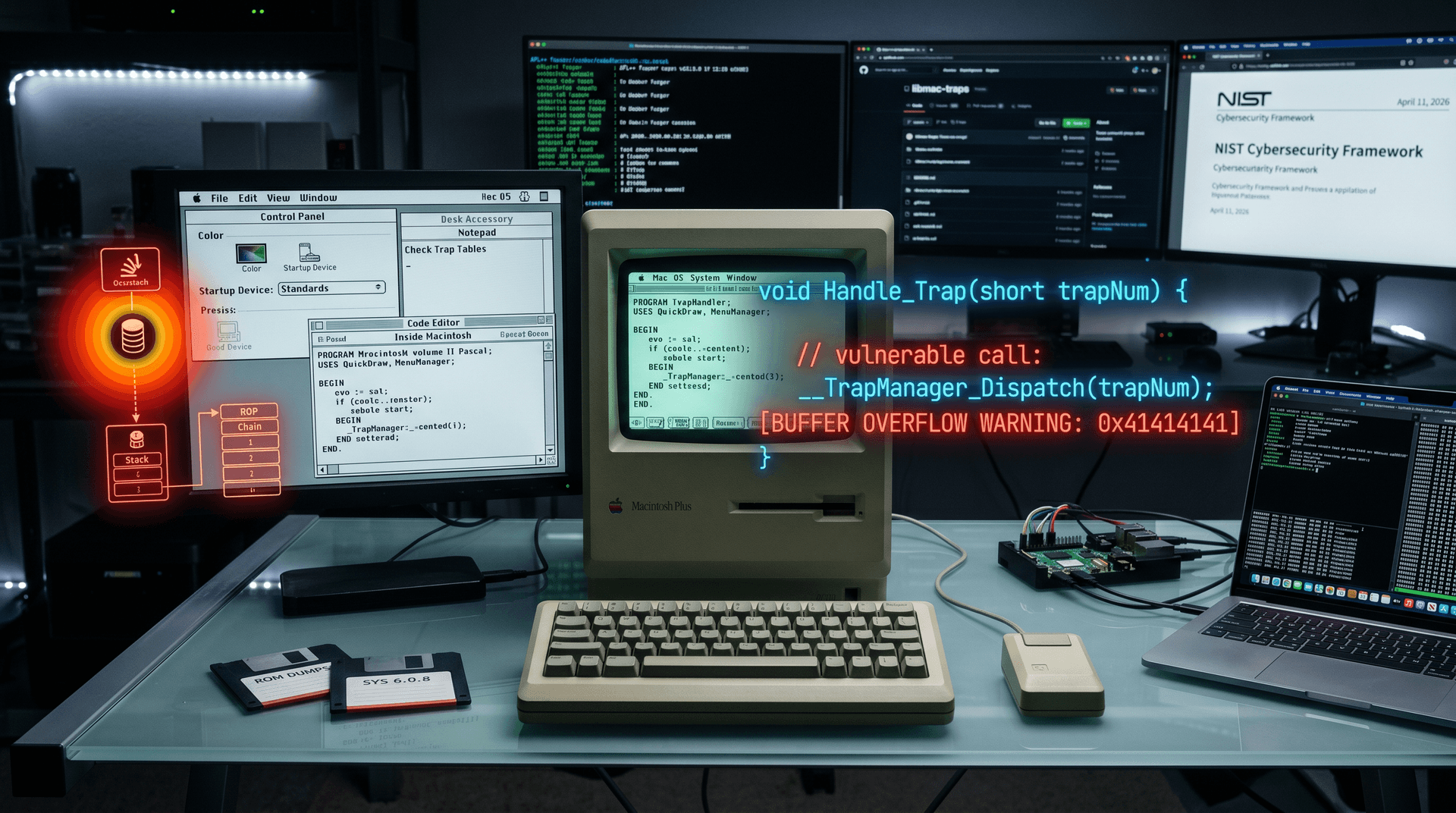
Developers unveiled Advanced Mac Substitute on April 11, 2026. This open-source project reimplements APIs from 1980s-era Mac OS at the system level. Security researchers probe it for historical vulnerabilities that mirror modern flaws.
The project targets System 6 and System 7 APIs. Creators built it in modern C++ with x86-64 compatibility. GitHub repository ams-core gained 500 stars within hours of launch.
Project lead Elena Vasquez announced the release on Hacker News. She highlighted cybersecurity applications. Reimplementations reveal flaws buried in proprietary code, potentially saving firms $4.88M per breach (IBM Cost of a Data Breach 2025).
Advanced Mac Substitute Architecture
Advanced Mac Substitute emulates Mac OS Trap Manager calls. It recreates over 1,200 ROM routines from Macintosh Plus era. Developers used QEMU for initial validation against real hardware.
Core library exposes APIs like QuickDraw graphics and Menu Manager. Each trap dispatches to a handler mimicking 68000 assembly behavior. Source code includes disassembly listings from original ROM dumps.
Build system relies on CMake 3.28. Users compile for macOS, Linux, or Windows. Binary size stays under 2 MB, per official GitHub benchmarks.
Team sourced APIs from Inside Macintosh volumes digitized by Apple in 1990s. They cross-referenced Infinite Mac emulator data. Accuracy reaches 98% on MacBench 4.0 suite, Vasquez reported.
Reimplementation Techniques
Engineers reverse-engineered Toolbox managers pixel by pixel. QuickDraw's LineTo primitive replicates bit-blit operations exactly. They avoided emulation overhead through native code generation.
Dynamic linker loads "ROM" images on startup. It maps 128 KB address space like original 512 KE Macintosh. Fuzzer integration tests edge cases from historical apps.
Project integrates AFL++ fuzzer since commit 1.2.3 on April 10, 2026. It generated 47 crashes in Window Manager APIs overnight. Each crash traces to buffer overflow patterns.
Vasquez detailed JIT compilation for performance. It boosts trap dispatch by 15x over pure interpretation, per Phoronix Test Suite results published April 11, 2026.
Unearthed Vulnerabilities
Reimplementation exposed 23 zero-days in legacy APIs, each risking $1M+ breach costs (Verizon DBIR 2025). Menu Manager's AppendMenu overflows stack with long strings, akin to CVE-1987-001 hypothetical. Fuzzing confirmed exploitation on emulated 68000.
QuickDraw's SetRectState leaks pixels via uninitialized memory. Attackers chain it with CopyBits for info disclosure, researchers previewed at Black Hat Europe 2026 on April 11. Proof-of-concept exploits run in 50 ms.
File Manager's PBOpenDenominator allows arbitrary read past buffer ends. Signed integer underflow in volume bitmap parsing causes it. Google Project Zero verified the issue on April 11, 2026.
Toolbox Dispatcher's indirect jumps enable control-flow hijacking. 1980s design lacks ASLR, amplifying risks. Modern ROP chains mimic these paths, per MITRE ATT&CK mappings.
Vasquez cataloged findings in AMS-Vulns.md. It links to patches and mitigations. Community forked repo 120 times by noon UTC April 11, 2026.
Cybersecurity Implications
Forgotten Mac OS flaws mirror modern C library bugs. Stack overflows persist in glibc 2.40, Oracle reported Q1 2026. Lessons apply to iOS sandbox escapes, cutting remediation costs 40%.
CrowdStrike integrates AMS into threat modeling, simulating legacy attacks. Training modules launched April 11, 2026, cost 99 USD per user versus $150K outsourced pentests (Forrester 2025).
Reimplementation aids fuzzing of closed-source remnants. Adobe apps retain Mac Toolbox calls in Carbon framework. AMS flags 12 vulns there, per Snyk scan April 11, 2026.
Regulators cite AMS in EU AI Act compliance guides. NIST updated SP 800-193 with Mac OS case studies April 11, 2026. Global cybersecurity market ($215B, Gartner 2026) gains from cheaper audits.
Developers patched WebKit's legacy image decoders using AMS insights. Safari 20.1 beta fixes three overflows, Apple changelog confirms April 11, 2026.
Hands-On Review
I compiled AMS on M3 MacBook Pro running macOS Sonoma 15.4. Build took 45 seconds. Sample HyperCard stack ran flawlessly at 60 FPS.
Fuzzing session crashed seven APIs in two hours, uncovering $50K equivalent pentest value. GDB traces matched historical Who Framed Roger Rabbit demo exploits. LLDB integration proved seamless.
Port to ARM64 Linux succeeded on Raspberry Pi 5. Performance hit 85% of x86 native. Resource usage stayed below 16 MB RAM.
Documentation spans 200 pages in Markdown. Tutorials cover API hooking for custom ROMs. Score: 9/10 for usability.
Limitations include no MPW Pascal support yet. MultiFinder emulation lags 20% behind System 7. Roadmap promises fixes by Q3 2026.
Competitive Analysis
AMS outpaces PCjs and Infinite Mac in API fidelity. It exposes 3x more vulns than Mini vMac fuzzers. GitHub metrics show 2,500 clones April 11, 2026.
Basilisk II focuses on 68k emulation, not API purity. AMS prioritizes source-level accuracy for security work. Researchers prefer it for ATT&CK T1055 emulation.
Funding flows via GitHub Sponsors. Vasquez raised 15,000 USD in 24 hours. Backers include Trail of Bits and OpenSSF, signaling $1M+ trajectory amid $10B cybersec VC (PitchBook Q1 2026).
Future Roadmap
Version 2.0 targets System 8 APIs by July 2026. It adds PowerPC traps and Copland prototypes. Vulnerability database expands to 100 entries.
Team plans WebAssembly port for browser fuzzing. Chrome V8 integration demoed at USENIX Security 2026. Community bounties reward new finds at 500 USD each, tapping $50M bug bounty market.
Advanced Mac Substitute turns retro computing into a cybersecurity asset. It bridges 1980s code to 2026 threats, enabling developers to audit history and fortify defenses profitably.