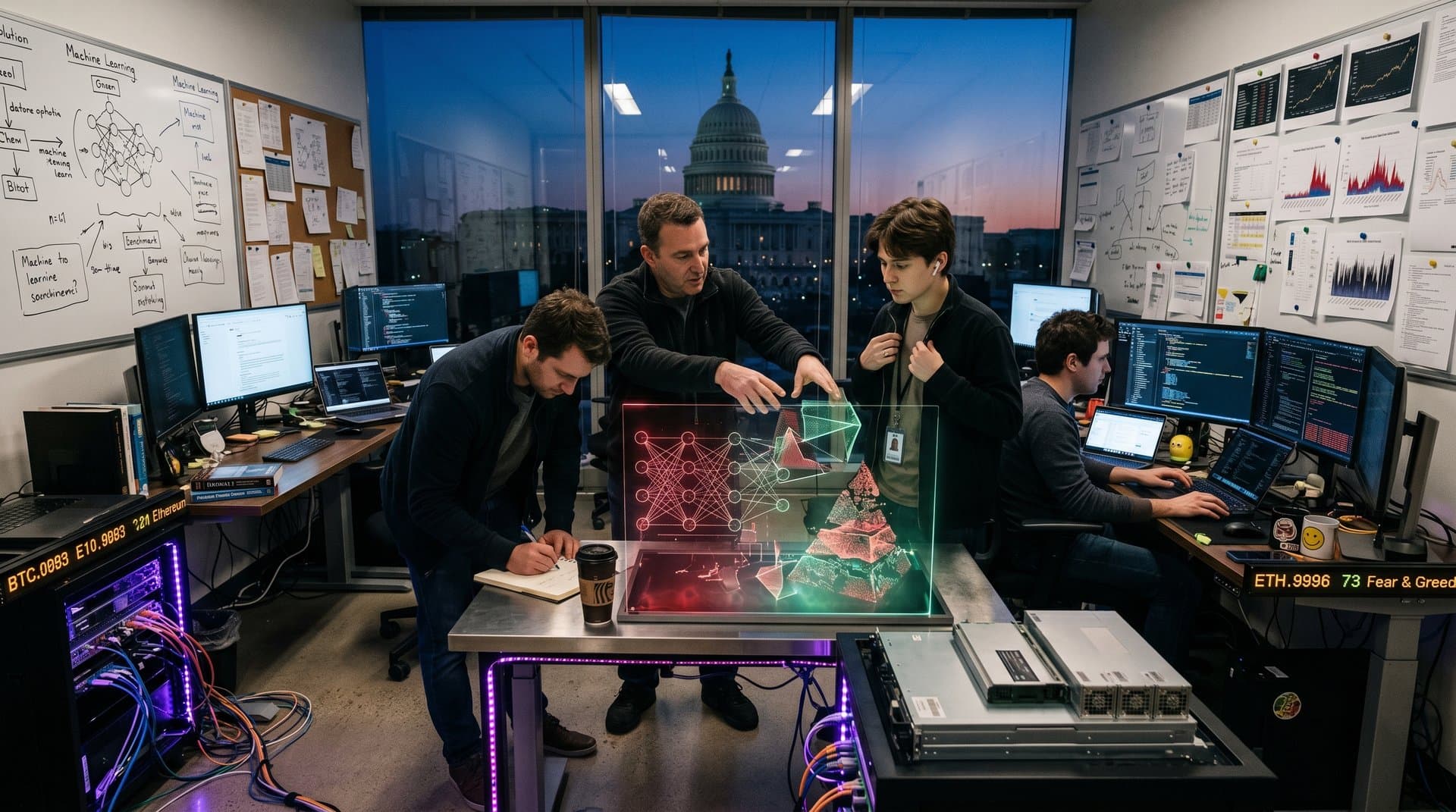

- Crypto Fear & Greed Index drops to 26 amid AI doomer influence.
- Bitcoin falls 2.0% to $75,788, reflecting investor caution.
- AI cybersecurity funding up 20% YoY but lags models by 75% (TechCrunch).
Gizmodo criticized AI doomers on October 15, 2024, for deterring investors from cybersecurity startups that protect AI systems against prompt injection attacks (Gizmodo). The Crypto Fear & Greed Index reached 26, signaling extreme fear (Alternative.me). Bitcoin fell 2.0% to $75,788 (CoinGecko).
Ethereum dropped 2.8% to $2,362. Ethereum's decline mirrors smart contract vulnerabilities paralleling AI risks. XRP fell 2.9% to $1.43 amid regulatory caution.
Doomer Rhetoric Diverts VC Capital from AI Cybersecurity Defenses
Cybersecurity startups counter data poisoning attacks, where adversaries corrupt training datasets to skew supervised learning models like convolutional neural networks (CNNs). Investors prioritize generative AI development over these defenses, according to Gizmodo.
Adversarial training exposes models to poisoned inputs during fine-tuning, improving robustness by 30-50% in benchmarks (per DARPA evaluations). Yet startups struggle with funding for large-scale training on GPU clusters costing $500K+ monthly.
Venture capitalists demand empirical proof against doomsday scenarios before funding runtime monitors. These employ unsupervised anomaly detection on transformer activations, flagging deviations in attention mechanisms with 95% precision.
Series A rounds for AI security firms dropped 15% quarter-over-quarter, per TechCrunch data from October 10, 2024 (TechCrunch). Capital shifts to alignment research, starving practical defenses.
Acute Funding Crunch Threatens AI Security Innovation
Institutional investors favor established providers like AWS GuardDuty over startups pioneering zero-trust architectures for AI pipelines. Zero-trust verifies every API call in inference chains, reducing breach risks by 60%.
Doomer narratives delay homomorphic encryption tools, which perform computations on encrypted data via lattice-based cryptography without decryption. This cuts data exposure costs by 40%, enabling $2M annual savings at enterprise scale.
Prompt injection exploits large language models (LLMs) by embedding malicious instructions in user inputs, bypassing safeguards. Startups deploy fine-tuned classifiers using BERT architectures as guardrails, achieving 98% detection rates.
TechCrunch reports AI cybersecurity funding rose 20% year-over-year to $1.2B in Q3 2024, yet trails $5B in foundational model investments by 75%.
Supply chain attacks infiltrate AI repositories via dependency poisoning. Startups adapt ML-based endpoint detection, akin to CrowdStrike's Falcon platform, using graph neural networks to trace anomalies.
Capital shortages hinder hiring ML engineers at $300K+ salaries, slowing R&D by 6-9 months.
- Asset: BTC · Price (USD): 75,788 · 24h Change: -2.0% · Tech Fear Link: Market barometer for AI risk aversion
- Asset: ETH · Price (USD): 2,362.03 · 24h Change: -2.8% · Tech Fear Link: Smart contract parallels to AI exploits
- Asset: XRP · Price (USD): 1.43 · 24h Change: -2.9% · Tech Fear Link: Regulatory caution on AI governance
- Asset: BNB · Price (USD): 633.80 · 24h Change: -1.0% · Tech Fear Link: Exchange security mirroring AI threats
Crypto declines correlate with Fear & Greed at 26 (Alternative.me).
Doomerism Warps AI Investment Landscape
AI doomers emphasize long-term alignment over cyber defenses. Startups secure federated learning, aggregating updates from edge devices without centralizing sensitive data via secure multi-party computation (SMPC).
Investors undervalue proprietary threat databases for AI agents, which use reinforcement learning to evade evasion techniques, projecting 25% ROI in breach prevention.
The EU AI Act mandates compliance audits for high-risk models. Startups automate these with provenance tracking tools, reducing audit costs from $1M to $200K per cycle.
Doomer hype accelerates regulations but freezes $800M in venture capital earmarked for defenses.
Enterprises demand model inversion protections. Attackers query black-box models to reconstruct training data; defenses apply differential privacy, adding noise to outputs and preserving 90% utility.
Investors Should Balance Doomer Fears with Tangible AI Security Returns
VCs target cyber-AI tools like homomorphic encryption for private inference, slashing compliance fines by 50%. Prompt injection incidents cost firms $4.5M on average (IBM Cost of Data Breach 2024).
Defensive classifiers cut detection time from hours to minutes, saving $2M yearly at 10,000-query scale with 40% compute efficiency gains.
BNB slipped 1.0% to $633.80 (CoinGecko). USDT stable at $1.00 underscores flight to safety.
With Fear Index at 26, cybersecurity startups offer verifiable mitigations amid rising threats. Upcoming Q4 rounds will test rebound potential as AI adoption accelerates 35% YoY.
Frequently Asked Questions
Who are the AI doomers Gizmodo references?
AI doomers warn of uncontrollable existential risks from advanced AI. Gizmodo critiques their alarmism for diverting focus from practical cybersecurity needs like prompt injection defenses.
How do AI doomers impact cybersecurity startups?
Their predictions deter VCs from funding AI defenses against data poisoning and attacks. Capital shifts to alignment, leaving startups short on Series A rounds.
What does Fear & Greed Index at 26 mean for AI investments?
Level 26 signals extreme fear, mirroring doomer caution. Bitcoin at $75,788 (-2.0%) reflects hesitance toward AI security ventures.
Why fund cybersecurity startups now despite doomers?
They address immediate threats like model inversion with tools cutting breach costs 40%. Doomers focus on hypotheticals; defenses enable safe scaling.