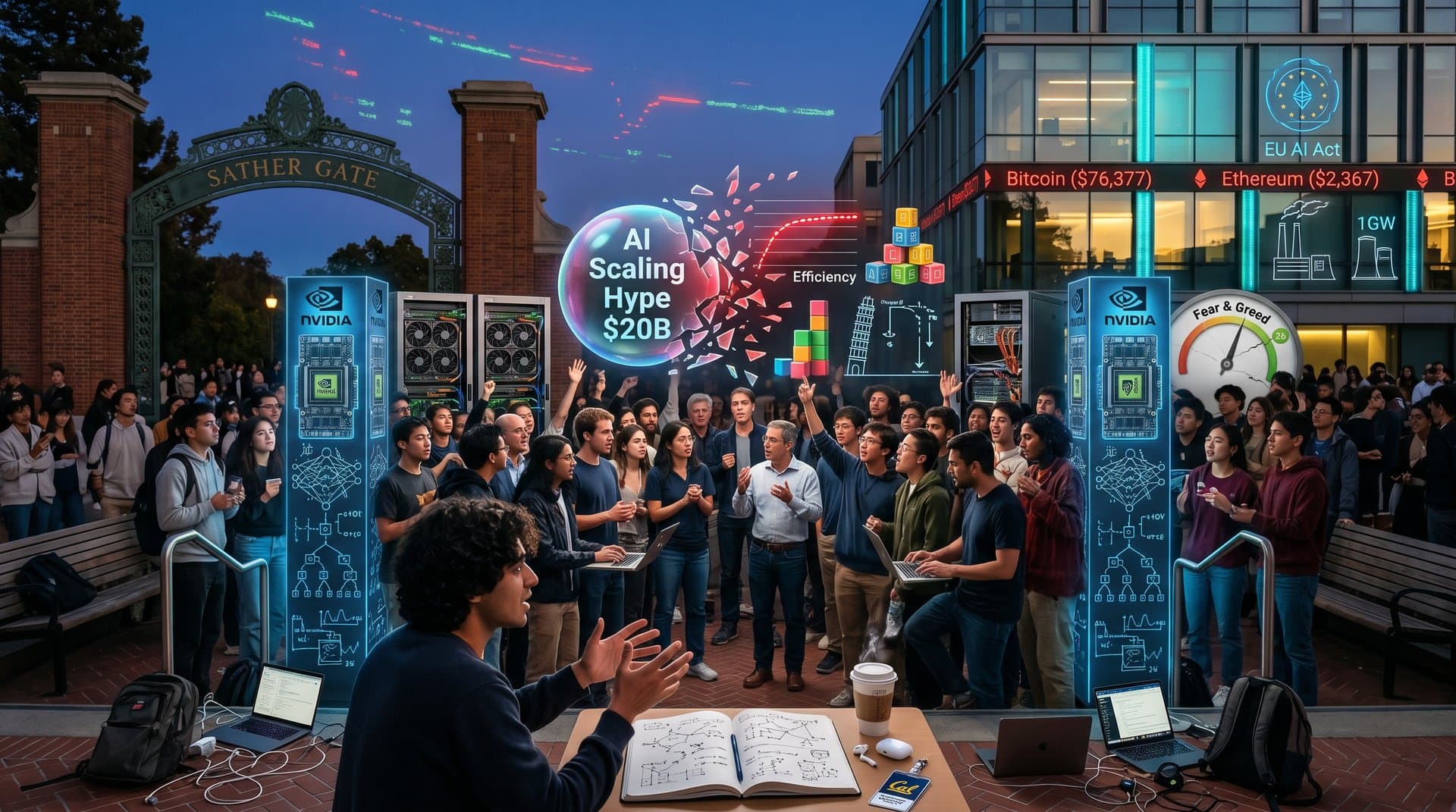
- 1. Berkeley's Abbeel highlights AI scaling hype's failure on 4-year-old common sense tasks like Winograd schemas.
- 2. Fear & Greed Index at 26 reflects investor skepticism toward $20B AGI roadmaps.
- 3. Startups pivot to hybrid neurosymbolic AI, saving up to 40% on compute costs.
UC Berkeley professor Pieter Abbeel warns that AI scaling hype ignores common sense mastered by 4-year-olds. Transformer-based large language models (LLMs) fail basic physics tasks despite trillions of parameters. AGI startups rethink $20B roadmaps as Alternative.me's Fear & Greed Index hits 26 on October 10, 2024. Bitcoin trades at $76,377 USD per CoinGecko. (68 words)
Toddler Common Sense Gap Reveals Core Flaws in AI Scaling Hype
Four-year-olds intuitively infer causality from minimal examples, like predicting a block tower's collapse. LLMs often hallucinate on object permanence or block-stacking tasks. Berkeley AI Research (BAIR) tests, detailed in their July 2023 blog post, show models score 20% below children on Winograd schemas—challenging pronoun disambiguation and commonsense reasoning, e.g., "The trophy doesn't fit because it's too big/large."
Kaplan et al.'s seminal scaling laws paper from OpenAI (2020) predicts performance improves with 10x compute on narrow tasks. Yet novel physics contexts plateau at 70% accuracy, per the study. Startups like xAI train 100B+ parameter models, burning $500M annually on 100,000 NVIDIA H100 GPUs, according to Reuters reports from July 2024.
Humans leverage innate priors for efficiency, needing far fewer examples. AI demands billions of tokens, inflating costs 40x compared to embodied learning, Abbeel explains in the Berkeley Talks podcast (September 2024 episode).
Berkeley Critique Disrupts $20B AGI Startup Roadmaps and Funding
OpenAI and Anthropic raised over $20B USD combined for scaling-driven AGI by 2030, per Crunchbase funding trackers as of October 2024. Abbeel pushes hybrid neurosymbolic systems, blending neural networks with symbolic logic for better reasoning.
xAI's Colossus supercluster costs $500M yearly in electricity and hardware alone, Reuters confirms. With Fear & Greed at 26, venture capital tightens—down 15% YoY for AI deals, PitchBook data shows. Startups pivot to active inference models mimicking child-like exploration, reducing data needs by 30-50%.
Investors prioritize efficiency. Cohere's retrieval-augmented generation (RAG) slashes inference costs 30%, per company benchmarks released August 2024.
Crypto Markets Mirror Investor Doubt on AI Scaling Hype
Bitcoin holds at $76,377 USD (up 0.7%), Ethereum at $2,367.80 USD (up 0.3%), and XRP at $1.44 USD (down 0.1%), all per CoinGecko on October 10, 2024. BNB trades at $633.78 USD (up 0.1%). AI tokens like Fetch.ai (FET) drop 5% amid skepticism.
MIT Technology Review's June 2024 article questions scaling laws' limits, citing diminishing returns beyond 10^24 FLOPs. EU AI Act, effective August 1, 2024, caps high-risk mega-clusters over 1GW power consumption.
Multimodal models like OpenAI's CLIP achieve 90% vision accuracy but only 50% on causal reasoning, per BAIR evaluations. Berkeley now develops intuition benchmarks exceeding MMLU's 85% LLM scores.
Hybrid Architectures and Robotics Pivot Reshapes AI Futures
Adept and Inflection secure $1B+ for agentic AI requiring true common sense. Ethereum's $2,367.80 USD price supports DeFi AI applications, while USDT stays stable at $1.00 USD.
Roadmaps shift to embodied AI and robotics, where physical interaction builds intuition. GPU shortages persist; TSMC reports 2-year backlogs for H100s as of Q3 2024. Power grids limit 1GW clusters, International Energy Agency (IEA) warns in their 2024 report.
Abbeel's critique challenges AI scaling hype dominance. Investors now demand verifiable intuition milestones before funding mega-clusters. Fear & Greed at 26 accelerates hybrid paths, potentially saving 40% on compute costs and unlocking $5B in efficient AI investments by 2025.
Frequently Asked Questions
What defines AI scaling hype per Berkeley?
AI scaling hype relies on bigger transformers via compute and data for AGI. Pieter Abbeel argues it ignores 4-year-old common sense. Hybrids like neurosymbolic AI emerge instead.
How does common sense gap impact AGI startups?
LLMs fail generalization despite trillions of parameters. Startups revise to neurosymbolic systems. Investors demand efficiency amid Fear & Greed at 26 and BTC at $76,377 USD.
Why critique AI scaling hype now?
BAIR tests show plateaus on physics tasks. Toddlers excel intuitively. Funding curbs and EU AI Act drive shifts.
What replaces pure AI scaling hype in startups?
Neurosymbolic AI and active inference slash data needs 40x. Berkeley supports embodied learning. Investors back Cohere and Adept hybrids.