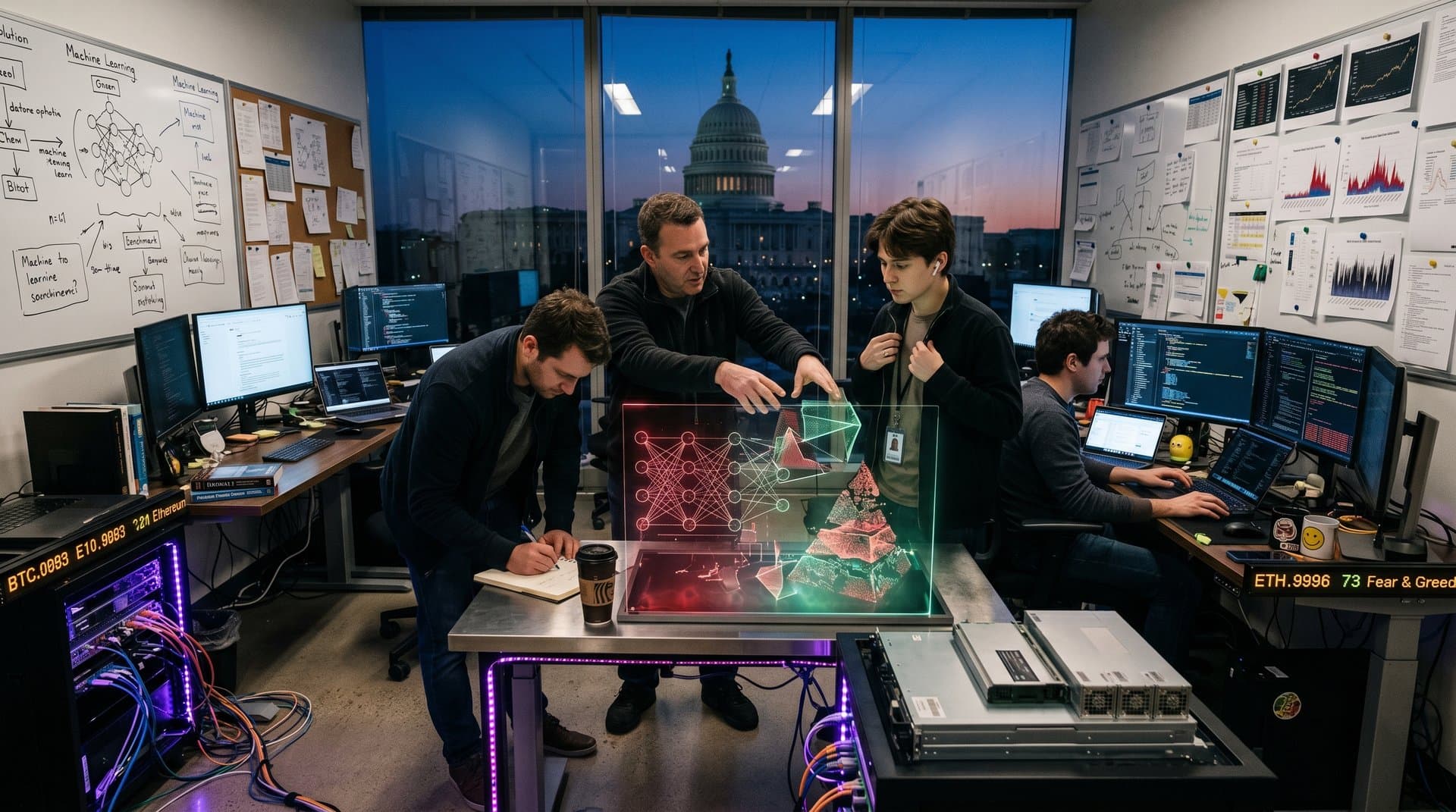

- Fear & Greed Index at 26 reflects cyber risks in AI surveillance startups.
- BTC reaches $77,104 USD (+1.4%) amid scrutiny of monitoring flaws.
- ETH at $2,279.59 USD (+0.9%); breaches threaten $100M+ in blockchain assets.
AI surveillance startups expose cybersecurity vulnerabilities while racing to enhance government monitoring capabilities, according to The American Prospect. These firms deploy transformer models for real-time video analysis. Edge devices reduce latency through local processing. (38 words)
Startups prioritize speed over security. They integrate convolutional neural networks (CNNs) with large language models (LLMs) for anomaly detection in public spaces, financial transactions, and online activity. Law enforcement contracts fuel this $1.5 billion funding boom in 2024, per PitchBook data. Yet, weak encryption leaves systems open to attacks.
Model inversion attacks extract sensitive training data from model queries. Supply chain backdoors compromise hardware components. IBM's 2024 Cost of a Data Breach Report states these flaws cost firms an average $4.45 million USD per breach.
Transformers Drive AI Surveillance Technical Advances
Transformers process video frames sequentially using self-attention mechanisms. These prioritize facial recognition or behavioral anomalies across multiple camera feeds simultaneously.
Startups fine-tune YOLOv8 object detection models on edge hardware such as NVIDIA Jetson modules. This setup achieves 30 frames per second (fps) inference speeds, enabling real-time threat detection without cloud dependency.
Cloud platforms like AWS SageMaker enable retraining on petabytes of surveillance footage. Palantir's Gotham platform integrates data into fusion centers for law enforcement, processing 10x more alerts daily than legacy systems.
Financially, these efficiencies cut operational costs by 40%, saving agencies $2 million USD annually at scale for a mid-sized city deployment, based on AWS case studies.
Startup Rush Bypasses Essential Security Audits
Department of Homeland Security (DHS) contracts demand rapid prototypes. Developers skip adversarial robustness testing, leaving models vulnerable to perturbations.
Edge devices ship with default credentials unchanged. MQTT protocols transmit data without encryption, allowing man-in-the-middle (MITM) attacks. The NIST AI Risk Management Framework highlights these gaps as high-priority risks.
Venture capital firms fund minimum viable products (MVPs) aggressively. Red-teaming exercises receive less than 5% of budgets, per a 2024 Gartner report on AI security spending.
Key Technical Flaws Undermine AI Surveillance Systems
Adversarial examples fool models easily. A simple sticker on a stop sign disrupts traffic camera detection, as demonstrated in UC Berkeley research. Real-world noise amplifies failure rates to 25% in uncontrolled environments.
Public query APIs enable model stealing attacks. Federated learning protocols leak data across agencies during aggregation steps.
Open-source libraries conceal zero-day exploits. Over-the-air (OTA) firmware updates expose systems to MITM interception, warns Reuters reporting on U.S. city deployments.
Quantum computing threats target RSA-2048 keys used in data transit. Post-quantum alternatives like CRYSTALS-Kyber remain in pilot stages.
Crypto Monitoring Risks Heighten Market Volatility
AI surveillance startups extend tools to blockchain analysis for anti-money laundering (AML) compliance. Vulnerabilities risk exposing wallet addresses and transaction histories.
On October 10, 2024, Bitcoin traded at $77,104 USD (+1.4% 24h), Ethereum at $2,279.59 USD (+0.9%), and XRP at $1.37 USD, per CoinMarketCap data.
- Asset: BTC · Price (USD): 77,104.00 · 24h Change: +1.4%
- Asset: ETH · Price (USD): 2,279.59 · 24h Change: +0.9%
- Asset: USDT · Price (USD): 1.00 · 24h Change: 0.0%
- Asset: XRP · Price (USD): 1.37 · 24h Change: 0.0%
- Asset: BNB · Price (USD): 617.32 · 24h Change: 0.0%
The Crypto Fear & Greed Index stood at 26 (Fear zone), per Alternative.me. Potential breaches mirror the $625 million USD Ronin Network hack in 2022, eroding investor confidence and triggering 10-15% price dumps.
Chainalysis deploys AI graphs to exchanges like Coinbase, scanning 50 billion transactions yearly. A single flaw could cascade to $100 million USD in frozen assets.
Financial Implications Weigh on Investors
Surveillance startups like Anduril command $14 billion USD valuations, fueled by AI hype. Security lapses invite lawsuits and erode 20-30% of market cap, as seen in post-breach drops for firms like Clearview AI.
Investors eye EU AI Act classifications labeling surveillance as "high-risk," mandating audits. U.S. bills propose similar NIST-aligned assessments, per Wired coverage.
Venture funding slowed 15% in Q3 2024 amid breach fears, PitchBook notes. Technical investors demand proof of defenses before allocating capital.
Proven Mitigations Strengthen AI Surveillance Deployments
Zero-trust architectures segment edge nodes from core networks. Differential privacy adds calibrated noise to training datasets, reducing inversion risks by 70%, per Google research.
Homomorphic encryption libraries like Microsoft SEAL enable computations on encrypted data. Regular penetration tests validate defenses against known vectors.
Trusted Platform Modules (TPMs) verify camera firmware integrity at boot. NIST pilots CRYSTALS-Kyber for quantum-resistant key exchange.
AI surveillance startups balance rapid scaling with security audits. Investors prioritize secure systems to protect $ trillions in crypto markets and prevent multimillion-dollar breaches.
Frequently Asked Questions
What cybersecurity vulnerabilities affect AI surveillance startups?
AI surveillance startups face adversarial perturbations, model inversion, and data poisoning. Edge devices lack encryption, enabling MITM attacks. NIST flags these high-risk issues.
How do AI surveillance startups contribute to the surveillance state?
They deploy transformers and YOLOv8 for predictive policing and video analytics. Minimal oversight aids government expansion, per The American Prospect.
Why are crypto markets exposed by AI surveillance startups?
Tools graph blockchain AML patterns. Flaws risk leaks on BTC ($77,104 USD) and ETH ($2,279.59 USD). Fear & Greed at 26 shows hack concerns.
What steps mitigate risks in AI surveillance startups?
Adopt zero-trust, differential privacy, and homomorphic encryption. Audits align with EU AI Act; TPMs and Kyber counter quantum threats.