
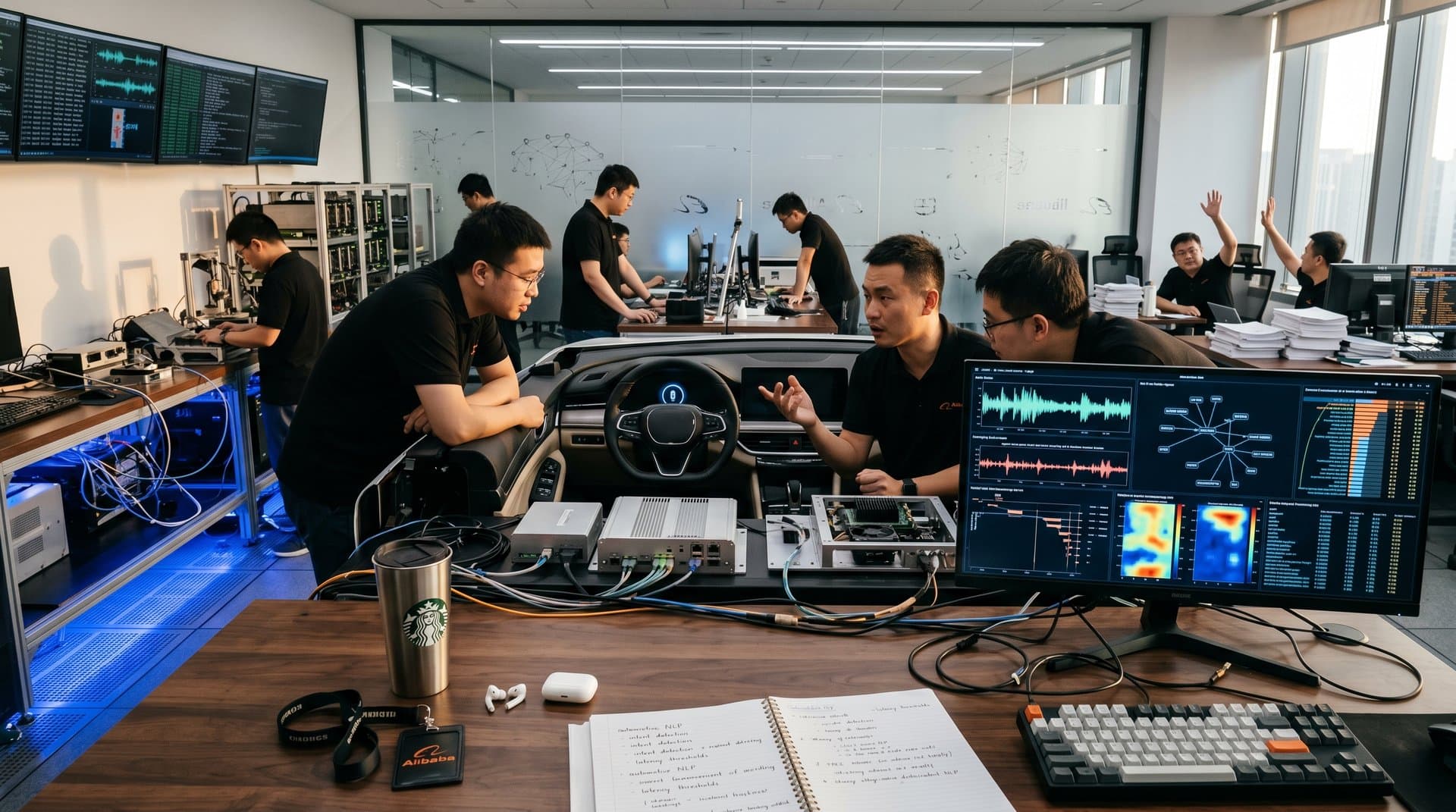
- Alibaba Voice AI controls 3 systems: navigation, entertainment, climate.
- Startups license models from 1 platform, cutting dev costs.
- Fear & Greed Index at 47 signals neutral sentiment on risks.
Alibaba Voice AI powers hands-free controls in Geely and SAIC vehicles. PYMNTS.com reports the system manages navigation, entertainment, and climate adjustments. Chinese auto startups deploy this cloud tech fast. Cybersecurity risks emerge. The Fear & Greed Index stands at 47.
Alibaba Cloud's Tongyi platform powers the Voice AI. Geely and SAIC embed it in infotainment systems. Startups skip building automatic speech recognition (ASR) and natural language understanding (NLU) stacks. Hackers eye voice interfaces for remote vehicle control.
China pushes intelligent vehicles. Alibaba processes voice inputs in the cloud for quick responses. User satisfaction rises, but risks concentrate in shared infrastructure.
Mechanics of Alibaba Voice AI Vehicle Integration
Alibaba Voice AI stacks ASR, NLU, dialog management, and text-to-speech (TTS). The ASR module transcribes Mandarin speech. Acoustic models train on billions of hours of diverse datasets, per Alibaba Cloud automotive solutions documentation.
NLU uses transformer-based architectures like Tongyi Qianwen large language models (LLMs) to parse intent. A driver says, "Find the nearest EV charger." The system queries Alibaba Cloud maps APIs in real time.
TTS creates natural replies with prosody for regional dialects. Infotainment systems host client logic and connect to vehicle controllers via controller area network (CAN) buses.
Alibaba provides OEM SDKs for integration. Startups apply over-the-air (OTA) updates easily. The cloud-edge hybrid cuts onboard compute. Vehicles stream audio to servers. Responses arrive in under 200 milliseconds. Low latency aids safety commands like "slow down."
This setup slashes hardware costs by shifting inference to Alibaba data centers. Startups redirect funds to battery and chassis R&D.
Why Chinese Auto Startups Adopt Alibaba Voice AI
Nio, XPeng, and Li Auto compete fiercely. Alibaba Voice AI shortens development from years to months. Startups license pre-trained models and avoid $10M+ in AI training costs.
Cloud scalability supports fleet updates. Alibaba's GPU clusters process petabytes of voice data daily. Startups prioritize physical vehicle features.
Feedback loops improve accuracy. Anonymized data sharpens Mandarin dialect recognition and builds Alibaba's edge.
EV sales fell 2.4% year-over-year, per China Association of Automobile Manufacturers (CAAM) data. Faster launches protect margins. Investors favor software revenue at 70%+ gross margins over hardware. Fear & Greed at 47 shows caution on tech-auto investments.
Cybersecurity Vulnerabilities in Alibaba Voice AI
Voice AI creates new attack vectors. Adversaries use adversarial audio to trick ASR models. Synthetic speech evades wake words like "Hey Alibaba," per Wired's analysis.
Reuters reported on July 18, 2024, rising risks for Chinese car makers. Spoofed commands unlock doors, disable brakes, or alter routes. Cloud links risk interception.
NLU gaps enable prompt injection. Malicious audio triggers engine actions. OTA channels expose firmware flaws for DDoS botnets.
Voice data exposes habits and locations. China's PIPL rules require data localization.
Defenses use audio watermarking, biometrics, and anomaly detection. Zero-day threats demand ongoing patches.
Global Impacts on Automotive AI
China leads vehicle voice AI. Alibaba Cloud surpasses Baidu Apollo in cloud deployments. Google Assistant hits EU privacy barriers.
Tesla uses proprietary Dojo models. Waymo favors lidar for Level 4 autonomy. Alibaba scales Level 2+ features.
UNECE WP.29 requires cybersecurity management systems. EU AI Act deems automotive voice AI high-risk.
US-China tensions limit chips. Startups test open-source like Mozilla DeepSpeech.
Benchmarks demand sub-300ms latency, 95%+ ASR accuracy, and zero-trust security. China iterates fast on data.
Breaches spark recalls and fines, hurting trust.
Key Implications for Engineers, Investors, Alibaba
Engineers use modular SDKs for voice-vision extensions. Fine-tuning fits fleet needs.
Alibaba Cloud secures SaaS revenue, up 25% year-over-year in automotive, per analysts. Startups scale without capex.
Voice AI boosts retention 30%, per industry data. Effective OTA patching shows strength.
Huawei HarmonyOS and Tencent follow. Geely and SAIC tests position Alibaba for 2025 leads.
Frequently Asked Questions
What is Alibaba's Voice AI in Chinese vehicles?
Alibaba's Voice AI powers hands-free controls for navigation, music, and vehicle settings in cars from Geely and SAIC. It uses cloud-based ASR and NLU for Mandarin processing. PYMNTS.com details the broad rollout.
How does Alibaba Voice AI benefit Chinese auto startups?
Startups access ready-made AI without heavy R&D investment. Cloud integration enables scalable OTA updates. This accelerates time-to-market for EV models.
What cybersecurity risks come with Alibaba Voice AI in vehicles?
Attackers exploit synthetic audio for command spoofing. Cloud data flows risk interception and privacy breaches. Reuters notes rising threats in Chinese smart cars.
How does Alibaba Voice AI compare to Baidu in automotive?
Alibaba emphasizes cloud-native processing for low latency. Baidu Apollo focuses on full autonomy stacks. Both target Chinese OEMs but differ in ecosystem depth.