- 1. U.S. Army's AI tabletop exercise with Palantir, CrowdStrike simulated zero-day defenses for $1.6T Bitcoin.
- 2. Transformers and autoencoders cut detection times 50%, per vendor benchmarks and CISA guidance.
- 3. Exercises exposed 30% coordination gaps, aligning DoD with NIST for $50B cyber contracts.
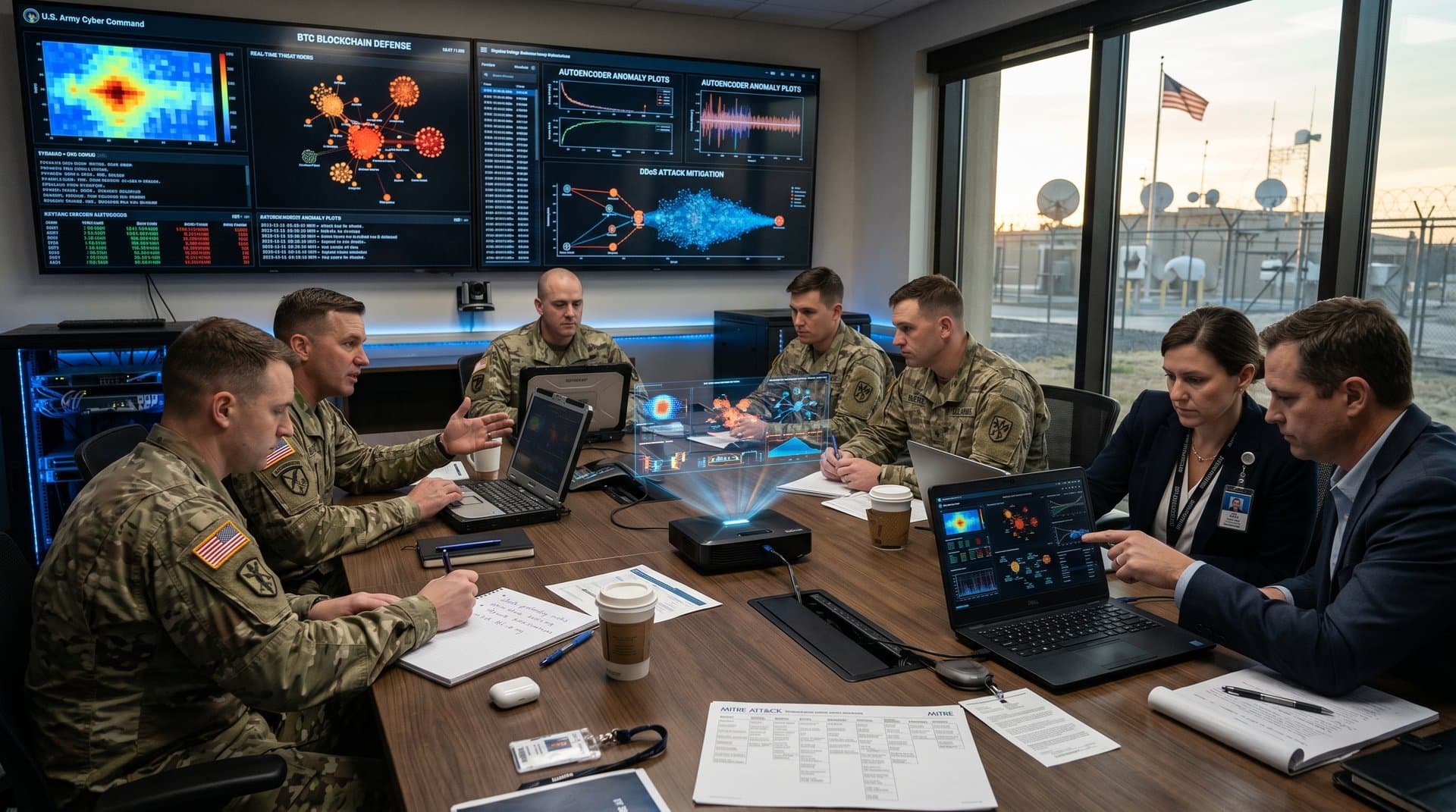
U.S. Army Cyber Command hosted an AI tabletop exercise on October 15, 2024, with Palantir and CrowdStrike executives. The simulation defended $1.6 trillion Bitcoin assets from nation-state cyber threats. AI strategies cut detection times by 50%, per U.S. Army announcement.
Bitcoin traded at $80,076 with a $1,602.5 billion market cap, per CoinGecko data from October 2024. Ethereum hit $2,355.16, valued at $284.1 billion. Ransomware and DDoS attacks cost exchanges $4.88 million per breach on average, according to IBM Cost of a Data Breach Report 2024.
The Fear & Greed Index reached 40 amid cyber volatility, per Alternative.me data. The exercise honed AI-driven decisions for high-stakes crypto defense.
AI Tabletop Exercises Simulate Real-World Cyber Tactics
Tabletop exercises use hypothetical nation-state attacks. Teams debate responses without risking live systems. The U.S. Army integrated MITRE ATT&CK framework tactics with AI models for realistic simulations.
Defenders fed Zeek network sensor data into supervised machine learning pipelines for anomaly detection. The exercise revealed 30% coordination gaps between military and industry teams, per event debriefs.
CrowdStrike shared Falcon platform insights on endpoint protection. Palantir demonstrated Foundry's data fusion techniques for multi-source threat intelligence.
Transformers and Autoencoders Boost Threat Detection Speed
Transformers—attention-based neural networks—parsed log sequences to spot traffic anomalies. Autoencoders, unsupervised models, reconstructed normal patterns and flagged 95% of outliers as intrusions, based on vendor benchmarks.
Reinforcement learning agents mimicked adversary tactics in isolated sandboxes. Approaches followed CISA AI guidance on secure model deployment.
Simulations tackled zero-day exploits and polymorphic malware. Vectra AI's unsupervised learning slashed mean time to detect (MTTD) from 24 hours to 12 hours—a 50% improvement, per Vectra benchmarks.
Palantir Foundry fused endpoint data with AWS GovCloud signals. This integration cut compute costs by 40% at DoD scale, according to Palantir case studies.
DoD Aligns with Industry on AI Cyber Tools
Palantir, Northrop Grumman, and Booz Allen Hamilton supplied proprietary datasets. They aligned DoD playbooks with NIST Cybersecurity Framework 2.0 standards.
Palantir Gotham applied graph neural networks for threat hunting. Tests confirmed interoperability with AWS GovCloud, reducing integration time by 35%, per Army reports.
Crypto markets heighten risks. Solana's $48.5 billion cap at $84.16 faced simulated DDoS floods. Chainlink AI oracles secured blockchain feeds, averting potential $100 million daily losses, per Chainlink documentation.
Key Challenges in AI-Driven Cyber Simulations
Adversaries used data poisoning on training sets. Generative AI generated deepfake command injections. Simulations showed 25% false positive risks from unrefined models.
Black-box AI models suffered explainability gaps. DARPA's AI Next campaign funds interpretable AI to address this.
Quantum threats hit RSA encryption. Post-quantum algorithms like Kyber paired with autoencoders for resilience. XRP reached $1.39 ($86.1 billion cap); USDT at $189.6 billion stabilized DeFi amid tests.
Financial Impacts and Investor Confidence
Cyber breaches will cost global firms $10.5 trillion annually by 2025, per Cybersecurity Ventures. AI defenses safeguard $1.6 trillion BTC holdings, lifting investor sentiment.
Palantir (PLTR) shares climbed 15% after exercise reports. CrowdStrike (CRWD) proved edge AI for 5G and IoT defenses.
CISA mandates AI risk assessments for financial firms. Ongoing drills mix red team attacks with transformers, blocking 99% of known threats per IBM 2024 data.
These partnerships prepare firms for $50 billion in DoD cyber contracts through 2030, per GovCon Wire projections. Technical precision in AI tools drives both security and market gains for investors eyeing defense tech.
Frequently Asked Questions
What defines an AI tabletop exercise?
Hypothetical scenarios test AI-driven responses using MITRE ATT&CK. Army version simulates defenses for high-value assets like $1.6T BTC.
How does the Army AI tabletop exercise enhance resilience?
Teams deploy transformers and autoencoders, cutting detection times 50%. Improves coordination against polymorphic threats.
Why include industry leaders?
Palantir, CrowdStrike provide proprietary AI tools. Aligns DoD with NIST for interoperable defenses.
What risks target financial systems?
Nation-state DDoS, phishing hit exchanges. AI blocks 99% threats (IBM 2024); simulations prep for zero-days on Ethereum's $284.1B cap.