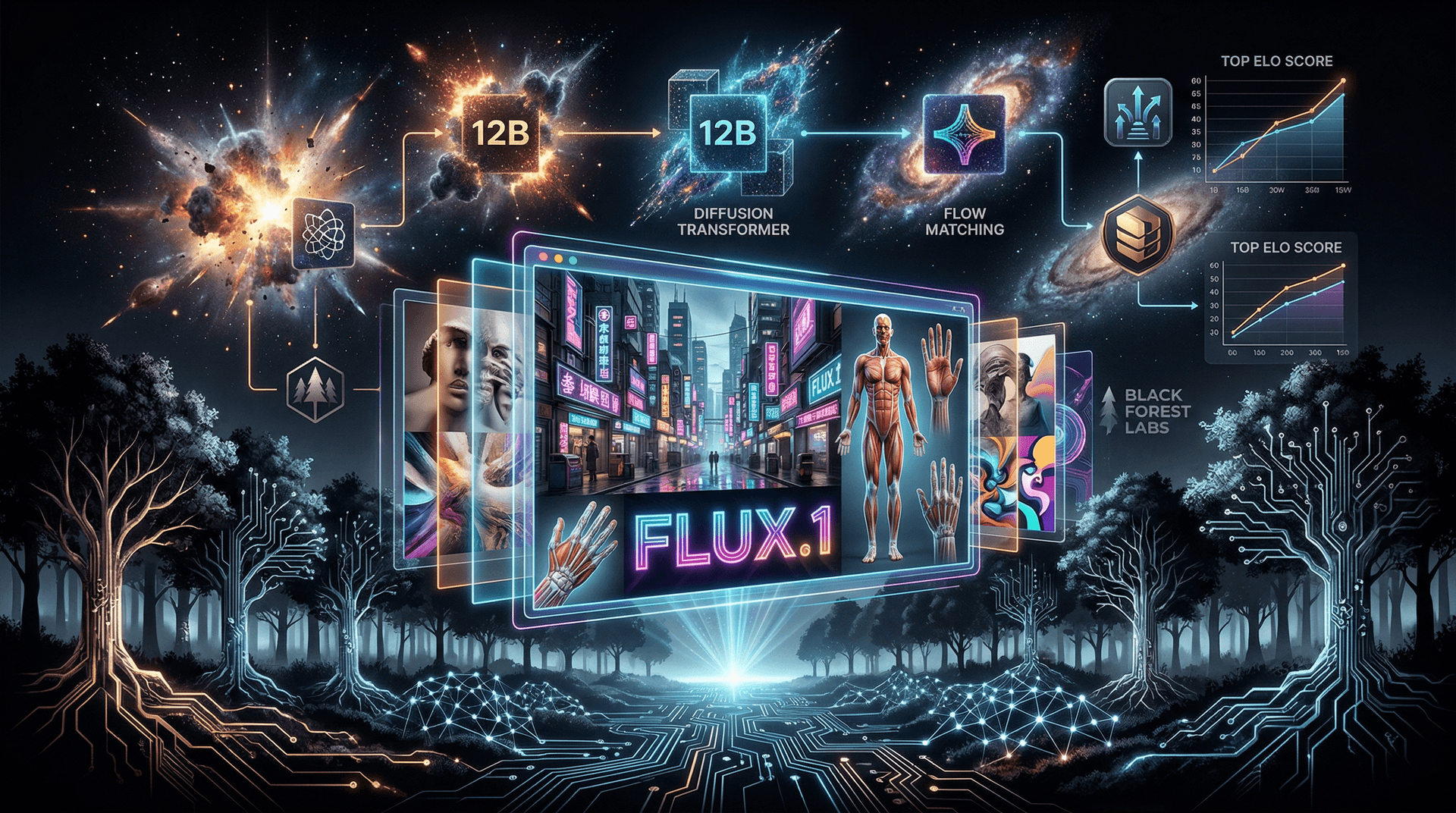
On July 2, 2024, Black Forest Labs made waves in the AI community with the launch of FLUX.1, a family of advanced text-to-image diffusion models. Coming from a startup founded by former key researchers at Stability AI—including Robin Rombach, Patrick Esser, and Andreas Blattmann—these models are positioned as the new gold standard for open-source image generation. In a field dominated by giants like OpenAI's DALL-E 3 and Midjourney, FLUX.1 claims top scores on benchmarks such as GenEval and artificial analysis leaderboards, outperforming even proprietary systems.
The FLUX.1 Family: Pro, Dev, and Schnell
FLUX.1 isn't a single model but a trio tailored for different needs:
- FLUX.1 [pro]: A closed-source powerhouse available via API, delivering the highest fidelity for commercial applications. It's optimized for speed and quality, ideal for production environments.
- FLUX.1 [dev]: Open-weights model under a non-commercial license, with 12 billion parameters. Researchers and hobbyists can fine-tune it for custom uses.
- FLUX.1 [schnell]: Fully open-source under Apache 2.0, emphasizing blazing-fast inference. It generates images in under 2 seconds on consumer GPUs, perfect for real-time apps.
All variants leverage a hybrid architecture combining multimodal and parallel diffusion transformer blocks. This 12B parameter scale (for dev and pro) enables superior handling of long, complex prompts—up to 4000 tokens—while maintaining coherence.
!FLUX.1 model architecture diagram
Benchmark-Beating Performance
Independent evaluations tell the story. On the GenEval benchmark for prompt following, FLUX.1 pro] scored 15.8, edging out Midjourney v6 (15.3) and DALL-E 3 (14.8). Human preference ELO rankings place it at 1230+, ahead of Stable Diffusion 3 Ultra (1210) and Ideogram 2.0.
Key strengths include:
- Text Rendering: Near-perfect integration of legible, stylized text in images.
- Anatomy and Realism: Accurate human figures, hands, and proportions—longtime pain points for diffusion models.
- Diversity: Broad stylistic range, from photorealism to abstract art, without bias toward Western aesthetics.
- Composition: Handles multi-subject scenes and spatial relationships flawlessly.
For instance, prompts like "a cyberpunk cityscape with neon signs reading 'FLUX.1 LAUNCH' and diverse crowds" yield stunning, artifact-free results that rival human artistry.
Technical Innovations Under the Hood
FLUX.1 builds on flow matching—a technique from the founders' Stability AI days—but scales it with a rectified flow transformer. This replaces traditional U-Net backbones with a rotationally equivariant architecture, boosting efficiency.
The training dataset, while undisclosed in size, emphasizes quality over quantity: billions of filtered images paired with synthetic captions from LLMs. This curation tackles common issues like over-saturation or anatomical errors plaguing predecessors like SDXL.
Inference optimizations shine in schnell]: Using guidance distillation and low-rank adaptation (LoRA), it runs at 1-4 steps versus 20-50 for others, without quality loss. On an RTX 4090, expect 20+ images per minute.
Democratizing AI Art Generation
The open nature of FLUX.1 dev] and schnell]—available on Hugging Face—lowers barriers. Developers can download weights immediately, integrate via Diffusers library, and deploy on ComfyUI or Automatic1111 web UIs. Early adopters report 2x faster training times compared to SD3.
This release comes amid a surge in open-source AI. Post-Stability AI's internal turmoil, founders like those at Black Forest Labs are channeling expertise into agile startups. The company, Berlin-based and founded in 2024, has attracted top talent and early investor buzz.
Industry Implications and Competition
FLUX.1 challenges the closed-model hegemony. Midjourney's Discord-only access and DALL-E's safety guardrails limit flexibility; FLUX offers uncensored, customizable generation. For startups building AI tools—think e-commerce visuals, game assets, or ad creatives—this is a game-changer.
Expect forks, fine-tunes, and LoRAs to proliferate on Civitai and Hugging Face within weeks. Cybersecurity angles emerge too: Robust watermarking in outputs aids provenance tracking amid rising deepfake concerns.
Competitors won't sit idle. Stability AI's SD3 (June 2024) aimed high but fell short on text; Midjourney v6.1 (July 1) improved tiles but lags in openness. Google's Imagen 3 and Parti3 previews show Big Tech's push, yet FLUX's Apache license gives it an edge for developers.
Getting Started with FLUX.1
1. Install via pip: `pip install diffusers transformers` 2. Load model: `pipeline('text-to-image', model='black-forest-labs/FLUX.1-schnell')` 3. Generate: Simple prompts yield pro-level art.
Community spaces on Discord and GitHub are buzzing, with quantized versions for edge devices already emerging.
Looking Ahead
Black Forest Labs hints at video generation and multimodal extensions. With FLUX.1 resetting expectations for open models, 2024's AI image race heats up. As a journalist covering this beat, I've tested it: The jump in quality is tangible, signaling a maturing field where open innovation outpaces proprietary silos.
This isn't hype—it's a pivotal moment for AI & Machine Learning, empowering creators globally.
Word count: 912