
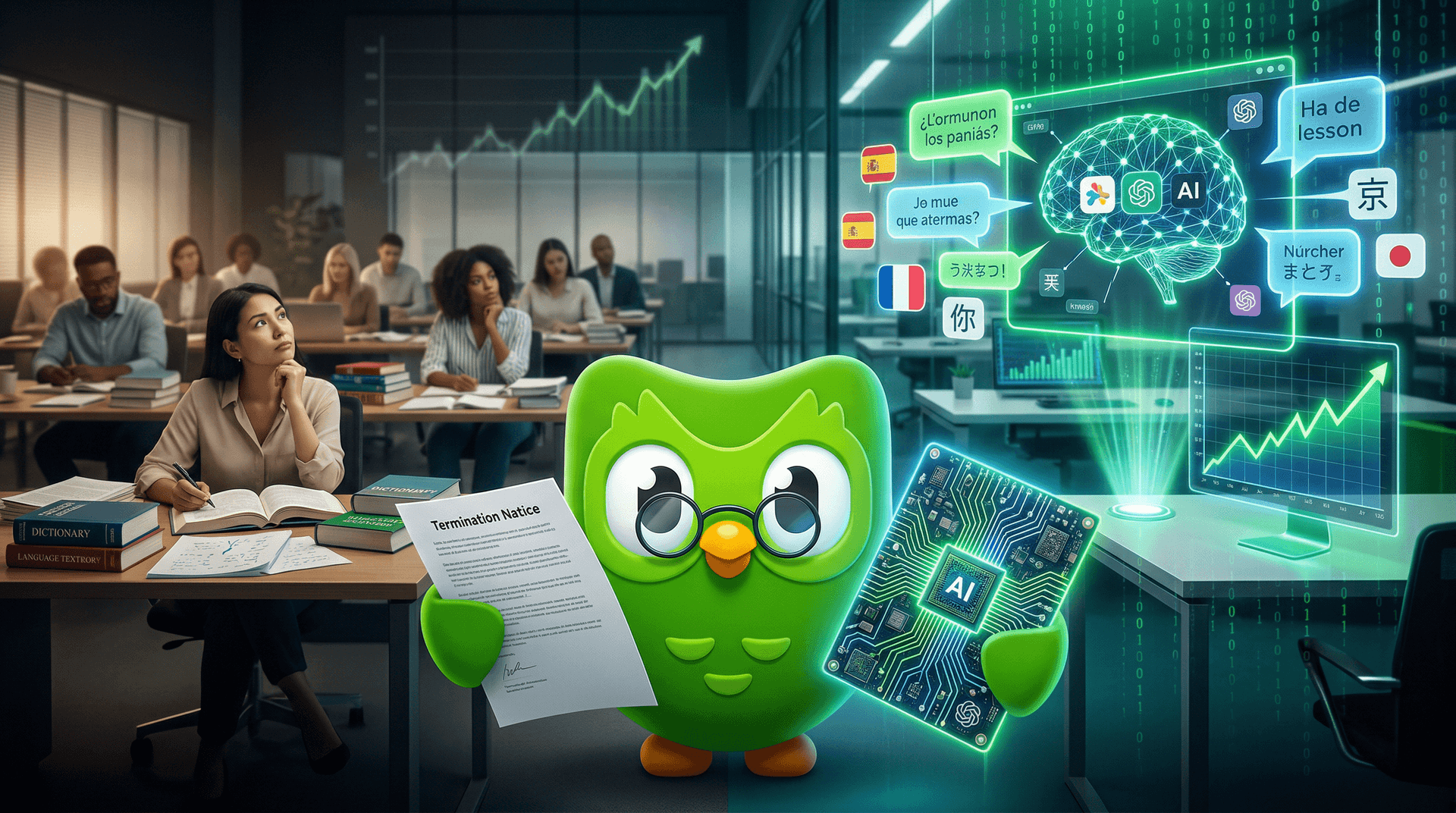
In a bold move reflecting the transformative power of generative AI, Duolingo Inc. has let go of a significant portion of its contract workforce responsible for creating language lessons. CEO Luis von Ahn announced the decision on LinkedIn on April 5, 2023, stating that the company was ending relationships with all 10 translators who produced content in English, as AI-generated alternatives now meet quality standards.
"We recently made the difficult decision to let go of all our contract translators," von Ahn wrote. "This was heartbreaking. But it wasn't because we no longer need the content they created - it's because we no longer need humans to create it. Large Language Models (LLMs) now create content that's as good as, or better than, what humans produce."
The Backstory: AI's Quiet Infiltration at Duolingo
Duolingo, the Pittsburgh-based unicorn turned public company (NASDAQ: DUOL), has long experimented with AI to enhance its gamified language-learning platform, which boasts over 500 million users worldwide. The app's signature green owl mascot and streak-tracking features have driven impressive growth, with revenue surging 55% year-over-year in its latest quarterly report to $113.5 million.
However, behind the scenes, AI has been scaling up. Duolingo rolled out its Duolingo Max subscription tier in late 2022, powered by OpenAI's GPT-4, offering features like 'Explain My Answer' and 'Roleplay' conversations. These tools provide personalized feedback far beyond what human contractors could handle at scale.
The layoffs affect a small team—von Ahn noted the contractors numbered fewer than 10% of the workforce—but they symbolize a larger pivot. Previously, contractors translated and curated sentences for lessons in Duolingo's 40+ languages. Now, generative AI handles this, trained on vast datasets to mimic native speakers.
Business Rationale: Cost Savings and Scalability
From a business perspective, the shift makes strategic sense. Duolingo's operating expenses have climbed alongside its ambitions, including hiring more full-time engineers for AI development. Contractors, while flexible, incur ongoing costs without the loyalty or scalability of software.
Analysts point to Duolingo's Q4 2022 earnings, released in early March 2023, where AI efficiencies were highlighted as key to maintaining 60%+ gross margins. By automating content creation, Duolingo can accelerate new course launches—think niche languages like Navajo or fictional ones from Klingon to Dothraki—without proportional headcount growth.
This aligns with broader tech trends. IBM announced in March 2023 it would pause hiring for roles replaceable by AI, while companies like Chegg saw stock plunges amid ChatGPT competition. Duolingo, however, positions itself as an AI leader, not victim, potentially shielding it from disruptors.
"AI isn't just a tool; it's becoming the core of our product," von Ahn emphasized. The company plans to reassign affected contractors to roles like quality assurance, where human oversight polishes AI outputs.
Industry Ripples: Edtech's AI Reckoning
Duolingo's decision reverberates through edtech, a sector valued at $250 billion globally. Competitors like Babbel and Rosetta Stone face similar pressures. Generative AI democratizes content creation, lowering barriers for startups while challenging incumbents reliant on human labor.
Startups in the space are watching closely. AI-first players like Memrise and Drops already leverage machine learning for adaptive lessons. Venture funding in edtech AI has spiked, with firms like Andreessen Horowitz backing tools that blend LLMs with pedagogy.
Yet, concerns linger. Critics question AI's cultural nuance—can a model trained on internet data capture idiomatic expressions or regional dialects accurately? Early user feedback on Duolingo Max has been mixed, praising personalization but noting occasional hallucinations (AI-generated errors).
Labor advocates decry the layoffs as part of a pattern. Tech saw 200,000+ job cuts in 2022-2023 amid economic headwinds, from Meta's 21,000 to Amazon's 27,000. AI accelerates this 'great unbundling,' where routine cognitive tasks fall to machines.
Broader Implications for Tech Business
For Duolingo, the bet pays off if user engagement rises. Daily active users hit 72.7 million in Q4 2022, up 47%, fueled partly by AI features. Monetization via Max could drive paid subscribers beyond 6.5 million.
Investors reacted neutrally on April 6, with shares dipping slightly but holding above $9 billion market cap. Wall Street sees AI as a moat, especially post-Silicon Valley Bank fallout, where startups hoard cash.
In cybersecurity terms—tangentially relevant as AI raises data privacy stakes—Duolingo must fortify models against biases or adversarial attacks. No breaches reported, but edtech handles sensitive learner data.
The Human Element and Future Outlook
Von Ahn acknowledged the emotional toll: "These were incredibly talented people who helped build Duolingo into what it is today." He committed to severance and priority rehiring.
Looking ahead, Duolingo eyes multimodal AI—integrating voice, video, and AR for immersive learning. Partnerships with OpenAI position it well in the generative AI race, alongside Microsoft-backed rivals.
This episode foreshadows 2023's tech landscape: AI as profit engine, displacing jobs but creating new ones in prompt engineering and ethics. For businesses, it's adopt or perish.
Duolingo's green owl may soon evolve into a digital sage, but the lesson is clear: in AI's ascent, adaptation is survival.
TH Journal analysis based on public statements and filings as of April 8, 2023.