
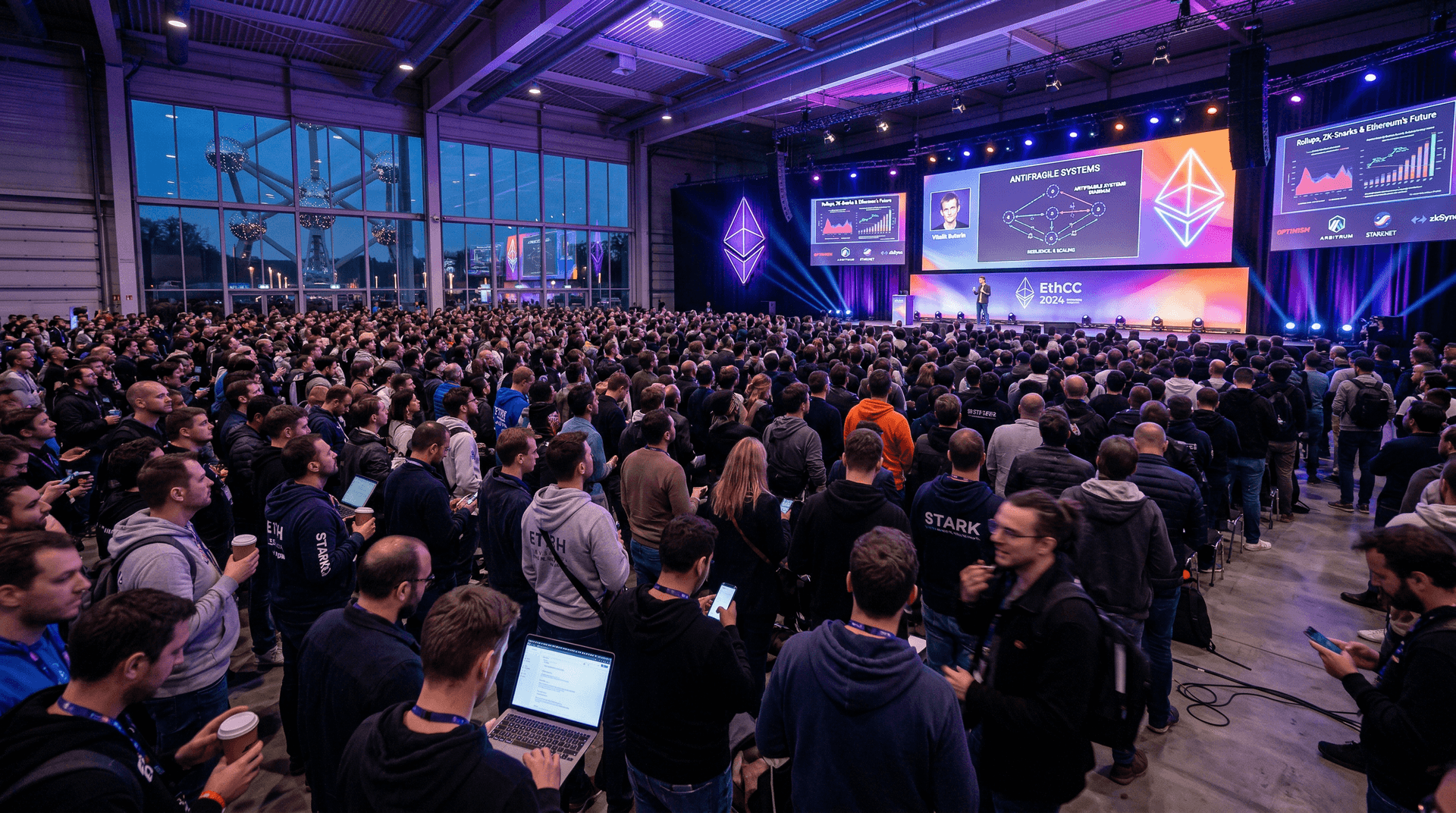
As of June 6, 2024, the sixth edition of Ethereum Community Conference (EthCC6]) has been a resounding success, transforming Brussels Expo into the epicenter of blockchain innovation. Kicking off on June 3, this four-day event attracted over 6,000 developers, researchers, founders, and enthusiasts from around the globe. Amid a bullish crypto market— with Ether trading near $3,800—attendees delved into critical topics shaping Ethereum's trajectory post-Dencun upgrade.
EthCC has evolved since its 2019 inception as a modest gathering into Europe's largest Ethereum-focused conference. Organized by the Ethereum community rather than a single entity, it emphasizes open-source ethos, featuring tracks like EF Devcon, Deep Dives, and ecosystem side events. This year's theme, loosely centered on "scaling and beyond," reflected Ethereum's maturation from proof-of-work to a robust proof-of-stake network with proto-danksharding live since March 13, 2024.
Vitalik Buterin's Keynote: Building Antifragile Systems
A highlight came on June 4 when Ethereum co-founder Vitalik Buterin took the main stage. In his talk titled "Being Anti-Fragile," Buterin explored how Ethereum can thrive amid volatility. Drawing from Nassim Taleb's concepts, he emphasized designing protocols that improve under stress—think L2 rollups handling surging transaction volumes without compromising security.
"Ethereum's strength lies in its composability and adaptability," Buterin noted. He recapped Dencun's EIP-4844, which introduced blobs to slash L2 data costs by up to 90%, enabling cheaper scaling. Real-world impacts? Arbitrum and Optimism saw fee reductions, boosting DeFi TVL to over $90 billion chain-wide.
Buterin also touched on account abstraction (ERC-4337), now battle-tested, allowing wallets to act like smart contracts. This paves the way for seamless user experiences, crucial for mass adoption.
Layer-2 Dominance: The Scaling Revolution
Layer-2 solutions dominated discussions. Panels featured leaders from Optimism, Arbitrum, Polygon, and zkSync. Optimism's Karl Floersch detailed the Superchain vision—a unified L2 ecosystem sharing security and liquidity. With 20+ chains in development, Superchain aims to process millions of TPS while settling to Ethereum L1.
Arbitrum's Orbit stack drew crowds, enabling custom chains for gaming and social apps. zkSync's hyperchains promised ZK-native scaling, with booting times under 24 hours. Attendees buzzed about real-world deployments: Base (Coinbase's L2) hit 10 million users, proving OP Stack's viability.
A packed session on "L2 Economics" dissected sequencer revenue models. Revenue-sharing mechanisms, like Arbitrum's DAO governance, ensure decentralization. Fees plummeted post-Dencun—from $0.50 to pennies—making Ethereum competitive with Solana for everyday use.
Restaking and EigenLayer: Shared Security Frontier
EigenLayer emerged as a breakout star. Co-founder Sreeram Kannan presented on restaking, where ETH stakers reuse their bonds to secure AVSs (Actively Validated Services). With $12 billion TVL by June 2024, EigenLayer's testnet showcased oracle networks and bridges.
Risks weren't ignored: slashing conditions and correlation attacks. Solutions like EigenDA (data availability layer) leverage Ethereum blobs for cheap, verifiable data posting. Symbiotic and Karak pitched alternatives, sparking debates on restaking's role in L2 security.
AI Meets Blockchain: New Horizons
Blending the site's AI niche, sessions explored on-chain AI. Projects like Ritual and AIT Protocol demoed decentralized inference on Ethereum L2s. SingularityNET's Ben Goertzel discussed AGI agents interacting via smart contracts, leveraging zero-knowledge proofs for private computations.
Privacy was key: ZKML (zero-knowledge machine learning) talks from Modulus Labs highlighted training models without exposing data. With Ethereum's Verkle trees on the roadmap (Pectra upgrade), state proofs could supercharge confidential AI.
Cybersecurity and Startups Spotlight
Cybersecurity panels addressed recent exploits, like the $300 million Bybit hack in February (lessons applied). MEV (Miner Extractable Value) mitigations via Flashbots' SUAVE drew interest, combating sandwich attacks plaguing DEXs.
Startup alley buzzed with pitches: Berachain (L1 with proof-of-liquidity), Manta Network (ZK privacy L2), and Celestia (modular DA). Funding rounds announced on-site underscored VC confidence—Paradigm led a $25 million raise for an L2 project pre-event.
Ecosystem Side Events and Networking
Beyond main stages, 200+ side events filled Brussels. Devcon ticket sales for Southeast Asia (upcoming November) sold out in hours. EF's Tim Beiko hosted roadmap AMAs, confirming Prague testnet for EIP-7702 (auth abstraction).
DeFi heavyweights—Uniswap's Hayden Adams, Aave's Stani Kulechov—shared updates. Uniswap v4 hooks enable custom logic, while Aave v3.2 brings cross-chain liquidity.
NFTs and socialfi evolved: Farcaster's Warpcast protocols gained traction for decentralized social graphs on Optimism.
Market Context and Outlook
ETH's rally, up 20% in May, rode ETF anticipation (filings from BlackRock, Fidelity post-May approvals). Bitcoin's post-halving stability bolstered alts. Analysts eyed $4,000 ETH by month-end, driven by L2 growth.
Challenges persist: Regulation (EU MiCA June 30), centralization risks in L2 sequencers. Yet optimism reigned—Ethereum processed 1.2 million daily txs, outpacing rivals.
As EthCC wrapped on June 6, recordings hit YouTube, ensuring global reach. This event solidified Ethereum's lead in programmable blockchains, blending scalability, security, and innovation.
Word count: 912