
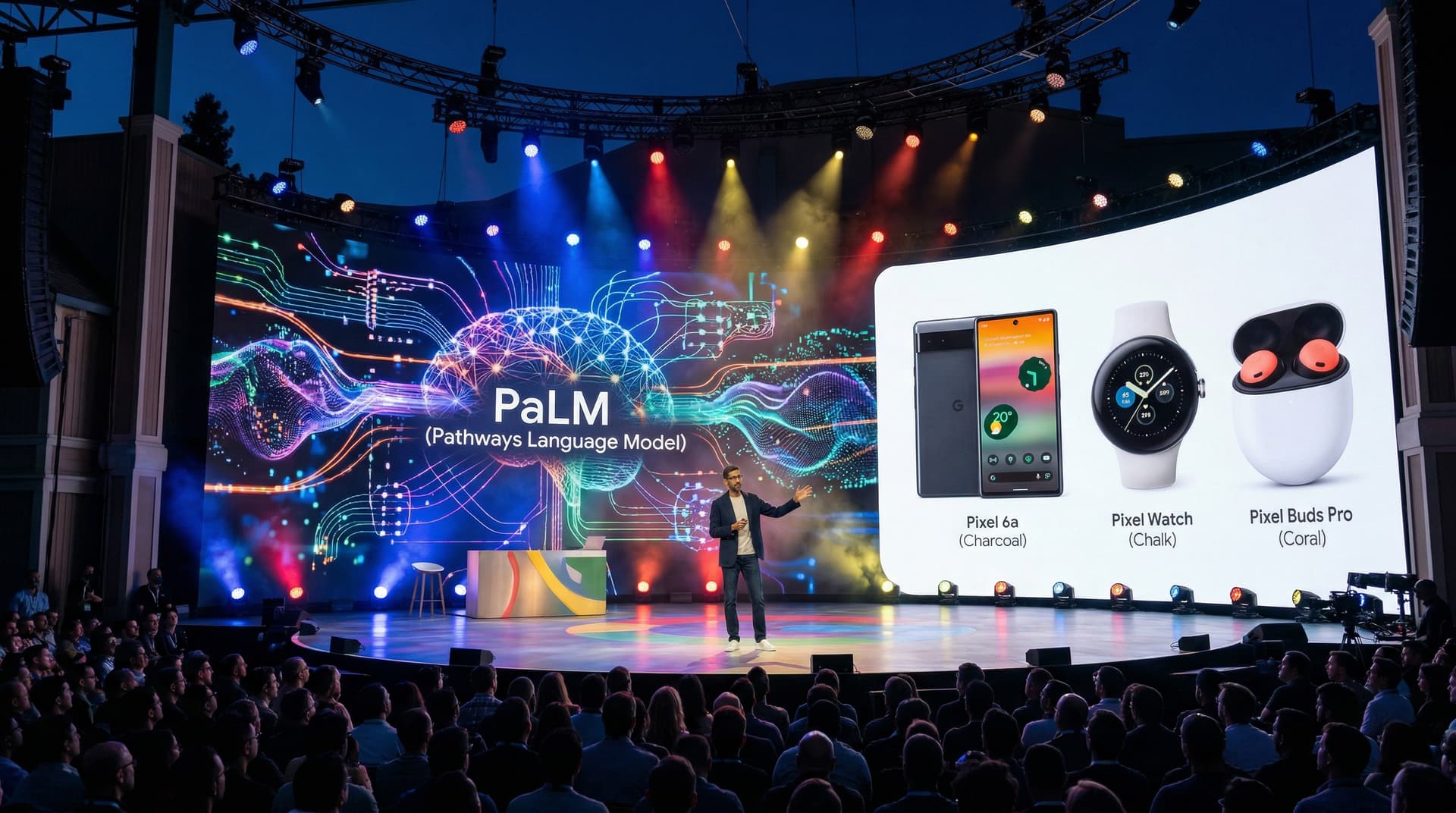
Google's annual developer conference, I/O 2022, held on May 11-12 at the Shoreline Amphitheatre in Mountain View, California, marked a pivotal moment for the tech giant. Amid a landscape dominated by economic uncertainty and fierce rivalry in artificial intelligence, Google showcased its Pathways Language Model (PaLM), a 540-billion-parameter AI system that promises to redefine consumer and enterprise applications. CEO Sundar Pichai emphasized an "AI-first" future, positioning these advancements as critical to Google's long-term growth strategy.
PaLM: The Backbone of Google's AI Ambitions
PaLM, first detailed in Google's April research paper, stole the spotlight with live demonstrations of its prowess. The model outperformed competitors like OpenAI's GPT-3 on benchmarks for reasoning, coding, and mathematics. In one demo, PaLM solved complex grade-school math problems with step-by-step explanations, a feat that highlights its potential for educational tools and enterprise analytics.
Business leaders took note of PaLM's multilingual capabilities, supporting translation into over 200 languages with nuanced cultural context. This could supercharge Google Cloud's AI services, appealing to global enterprises seeking scalable natural language processing. For startups, Google's release of PaLM APIs via Google Cloud opens doors for rapid prototyping of AI-powered apps, potentially accelerating innovation in sectors like customer service chatbots and content generation.
Pichai also teased generative AI experiences, including text-to-image synthesis akin to DALL-E but integrated seamlessly into Search and Workspace. While not fully rolled out, these previews signal Google's intent to embed generative AI across its ecosystem, challenging Microsoft and startups like Anthropic in the race for multimodal AI dominance.
Hardware Refresh: Pixel Lineup Democratizes Premium Tech
Complementing the AI focus, Google unveiled consumer hardware aimed at capturing market share from Apple and Samsung. The Pixel 6a, priced at $449, brings Tensor chip-powered AI features like photo unblurring, real-time translation, and advanced spam detection to a mid-range device. With 5G support and a 4,410mAh battery, it targets budget-conscious consumers and businesses needing reliable mobile productivity tools.
The first Pixel Watch ($349 starting) enters the wearables fray with Fitbit integration, offering ECG, blood oxygen monitoring, and AI-driven workout insights. Pixel Buds Pro ($199) feature active noise cancellation and spatial audio, leveraging Tensor for on-device AI processing. These launches represent Google's bold hardware bet, projected to boost Pixel shipments by 50% in 2022, per analyst estimates from Counterpoint Research.
From a business perspective, this hardware trio enhances Google's services revenue. Pixel devices drive adoption of Google Photos, Assistant, and Workspace, creating sticky ecosystems. For startups building on Android, the new Material You design system and Android 13 beta—emphasizing privacy with enhanced sandboxing—provide tools to craft personalized, secure apps.
Android 13 and Ecosystem Expansions
Android 13, entering beta, introduces spatial audio, per-app language settings, and the Privacy Sandbox to phase out third-party cookies. This aligns with regulatory pressures from the EU's GDPR and U.S. antitrust scrutiny, positioning Google as a privacy leader. Developers praised the Multi-Dimensional Capsule Network (MDCN) in Tensor G2 for efficient on-device ML, reducing cloud dependency and costs for edge AI applications.
Google also previewed Project Starline, a 3D teleconferencing tech using AI and light fields for lifelike remote interactions. Piloted with HP and Zoom, it targets enterprise video collaboration, potentially disrupting tools like Microsoft Teams.
Business Implications in a Competitive Arena
Google I/O arrives as Big Tech grapples with macroeconomic headwinds. Inflation and supply chain woes have tempered hardware enthusiasm, yet Google's affordable pricing strategy could insulate it. PaLM's edge over GPT-3 in efficiency (trained on fewer resources) appeals to cost-sensitive enterprises, bolstering Google Cloud's 11% market share chase against AWS and Azure.
Investors reacted positively; Alphabet shares rose 2% post-event, reflecting confidence in AI monetization. For cybersecurity, enhanced on-device processing in Pixel devices minimizes data transmission risks, a boon amid rising ransomware threats. Startups can leverage free PaLM checkpoints for fine-tuning, fostering an AI developer economy.
Competitors loom large: Apple's M1 Ultra and Samsung's Galaxy ecosystem challenge Pixel, while OpenAI's funding spree intensifies AI rivalry. Google's integrated approach—hardware, OS, cloud—gives it a moat, but execution will be key.
Looking Ahead: AI as Google's Growth Engine
I/O 2022 reaffirms Google's pivot from search dependency. With ad revenue facing privacy hurdles, AI-infused products like smart replies in Gmail and predictive search could unlock new streams. Analysts at Gartner forecast AI software markets hitting $62B by 2022, with Google well-placed to claim a slice.
For cybersecurity firms, PaLM's reasoning could power threat detection; startups might build PaLM-based anomaly detectors. In finance tech, its math prowess suits algorithmic trading aids.
As Google rolls out these innovations, expect ripple effects across tech. I/O wasn't just a showcase—it was a battle cry in the AI arms race, with business stakes higher than ever.
(Word count: 912)