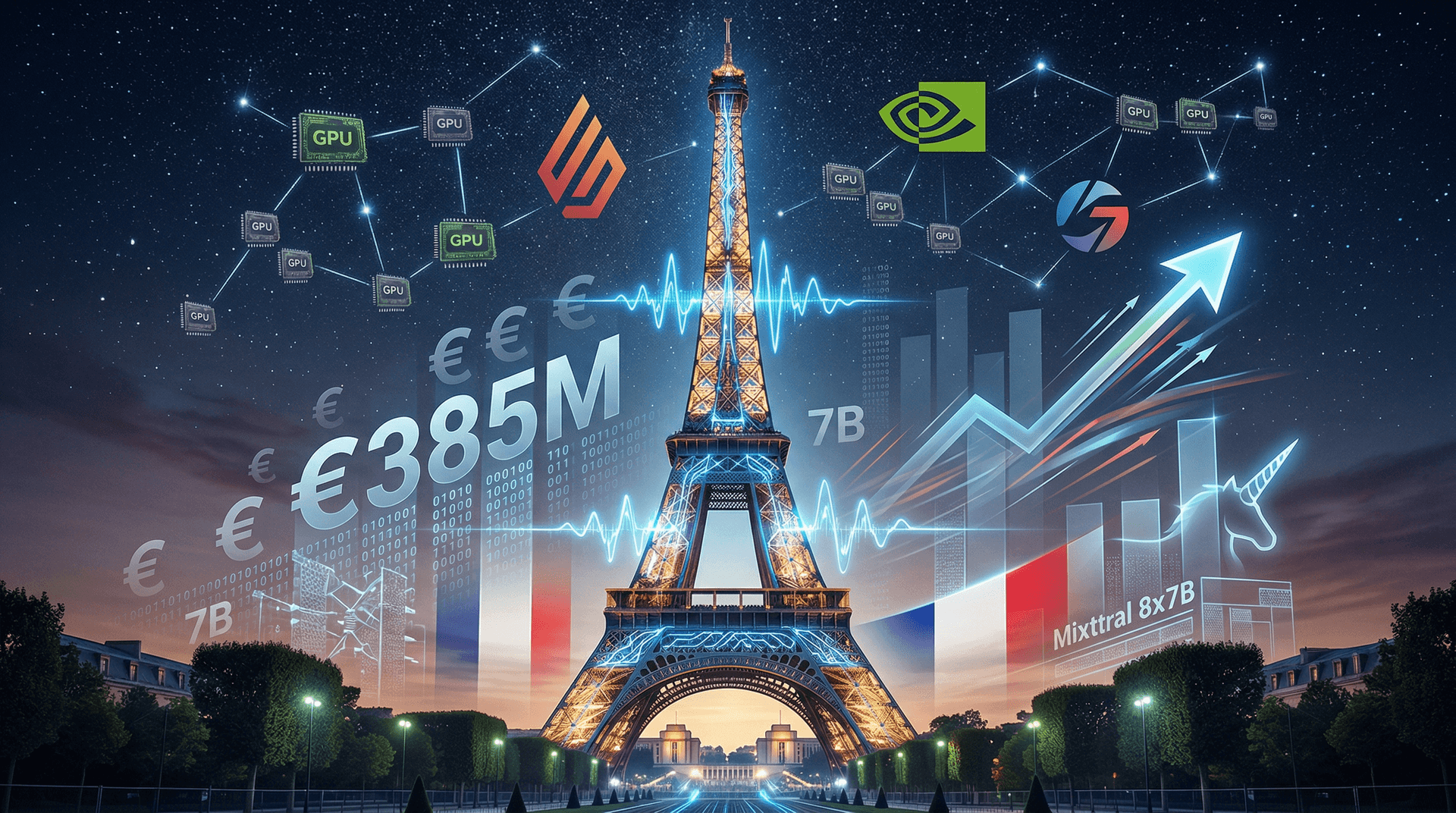
In a seismic shift for the European tech landscape, Paris-based startup Mistral AI announced on January 25, 2024, a whopping €385 million ($415 million) funding round. This Series A extension catapults the seven-month-old company to a €2 billion post-money valuation, making it Europe's most valuable AI startup and one of the fastest unicorns ever minted.
Founded in June 2023 by Arthur Mensch, Guillaume Lample, and Timothée Lacroix—former researchers at Google DeepMind and Meta—Mistral AI has disrupted the AI arena with its efficient, open-weight language models. The round was led by Lightspeed Venture Partners and General Catalyst, with participation from Nvidia, Bpifrance, and Salesforce Ventures. Notably absent from the investor list are U.S. hyperscalers like Microsoft or Amazon, signaling Mistral's intent to remain independent.
Rapid Rise from Obscurity to Unicorn Status
Mistral's ascent is nothing short of meteoric. Just weeks after its stealth launch, the company unveiled Mistral 7B in September 2023—a compact 7-billion-parameter model that punched above its weight, surpassing Meta's larger Llama 2 13B on key benchmarks like MMLU and HumanEval. This open-source release democratized access to high-performance AI, drawing millions of downloads and praise from developers worldwide.
Building on this momentum, Mistral dropped Mixtral 8x7B in December 2023, a mixture-of-experts (MoE) model boasting 46.7 billion parameters but activating only 12.9 billion per token for efficiency. It rivaled or beat GPT-3.5 on benchmarks while running on modest hardware, underscoring Mistral's focus on cost-effective inference.
Prior to this round, Mistral had raised €105 million in seed funding at a €260 million valuation. The new capital more than triples that figure, reflecting explosive demand for European alternatives to U.S.-dominated AI stacks.
Arthur Mensch, CEO and co-founder, stated in the announcement: "We are building the best models in the world, and today’s investment will allow us to invest in world-class infrastructure and talent to accelerate our roadmap." This underscores Mistral's plans to scale compute resources amid the global AI arms race.
Strategic Investors and Geopolitical Tailwinds
The investor syndicate reads like a who's who of tech powerhouses. Lightspeed, which led Anthropic's $450 million round, brings deep AI expertise. General Catalyst, backer of Stripe and Airbnb, adds fintech and scaling prowess. Nvidia's involvement is particularly telling—its GPUs power most frontier models, and CEO Jensen Huang has voiced support for diverse AI ecosystems.
Bpifrance, France's public investment bank, signals strong governmental backing. France has emerged as Europe's AI hub, buoyed by Macron's €6.5 billion AI investment plan announced at VivaTech 2023. This contrasts with the U.S., where regulatory scrutiny on Big Tech intensifies.
Mistral's open-source ethos also appeals amid growing concerns over closed models' black-box nature. By releasing weights under Apache 2.0, Mistral fosters innovation while monetizing via enterprise APIs and hosted services, similar to Hugging Face's model.
Europe's AI Awakening Amid U.S. Dominance
The funding arrives as Europe seeks to claw back ground in AI. OpenAI's ChatGPT sparked a frenzy, but U.S. firms like OpenAI (valued at $80B+), Anthropic ($18B+), and xAI ($24B) lead. Europe's lag stems from fragmented compute access and talent poaching.
Yet startups like Mistral, Aleph Alpha (Germany), and Stability AI (UK) are bridging the gap. Mistral's models integrate seamlessly with Hugging Face's ecosystem, boasting over 1,000 deployments. Its Le Chat chatbot rivals ChatGPT, available via API with pricing starting at $0.25 per million input tokens—competitive with incumbents.
This round values Mistral at €2 billion, surpassing UiPath's IPO valuation in 2021 and rivaling French decacorn Deezer. It highlights a shift: AI startups now command premiums based on model performance, not just user growth.
What Lies Ahead: Infrastructure and Frontier Models
With fresh funds, Mistral eyes massive infra buildout. CEO Mensch hinted at H100 GPU clusters rivaling those of rivals. Upcoming releases include Mistral Large, a closed flagship model, and domain-specific variants for coding and multilingual tasks—crucial for Europe's 24 languages.
Talent acquisition is key. Mistral has grown to 40 employees; expect hires from FAIR, DeepMind, and Inria. The company also launched La Plateforme, a self-serve fine-tuning service, accelerating enterprise adoption.
Challenges loom: Energy costs in Europe dwarf U.S. subsidies, and data sovereignty under GDPR complicates training. Still, Mistral's efficiency-first approach—models 10x smaller than GPT-4 yet comparable—mitigates this.
Broader Implications for Startups and Investors
Mistral's success validates Europe's startup renaissance. French VCs like Elaia and Idinvest, plus U.S. crossings, poured billions into AI last year. This round could spark a wave, with similar bets on Cohere or Together AI.
For cybersecurity and startups, Mistral's open models enable secure, on-prem deployments—vital for regulated sectors like finance and healthcare. As AI integrates into stacks, startups building atop Mistral gain edges in speed and cost.
In the finance realm, this funding underscores AI's investment allure. Valuations detached from revenue (Mistral's ARR reportedly under $10M) bet on optionality in a trillion-dollar market. Risks? Hype cycles and compute bottlenecks.
Conclusion: A Beacon for Sovereign AI
Mistral AI's €385 million haul isn't just a funding story—it's a manifesto for European technological sovereignty. In seven months, it has built models that challenge Silicon Valley giants, attracted blue-chip backers, and ignited national pride. As the AI race intensifies, watch Mistral: it may redefine not just open-source AI, but the global balance of tech power.
Word count: 912