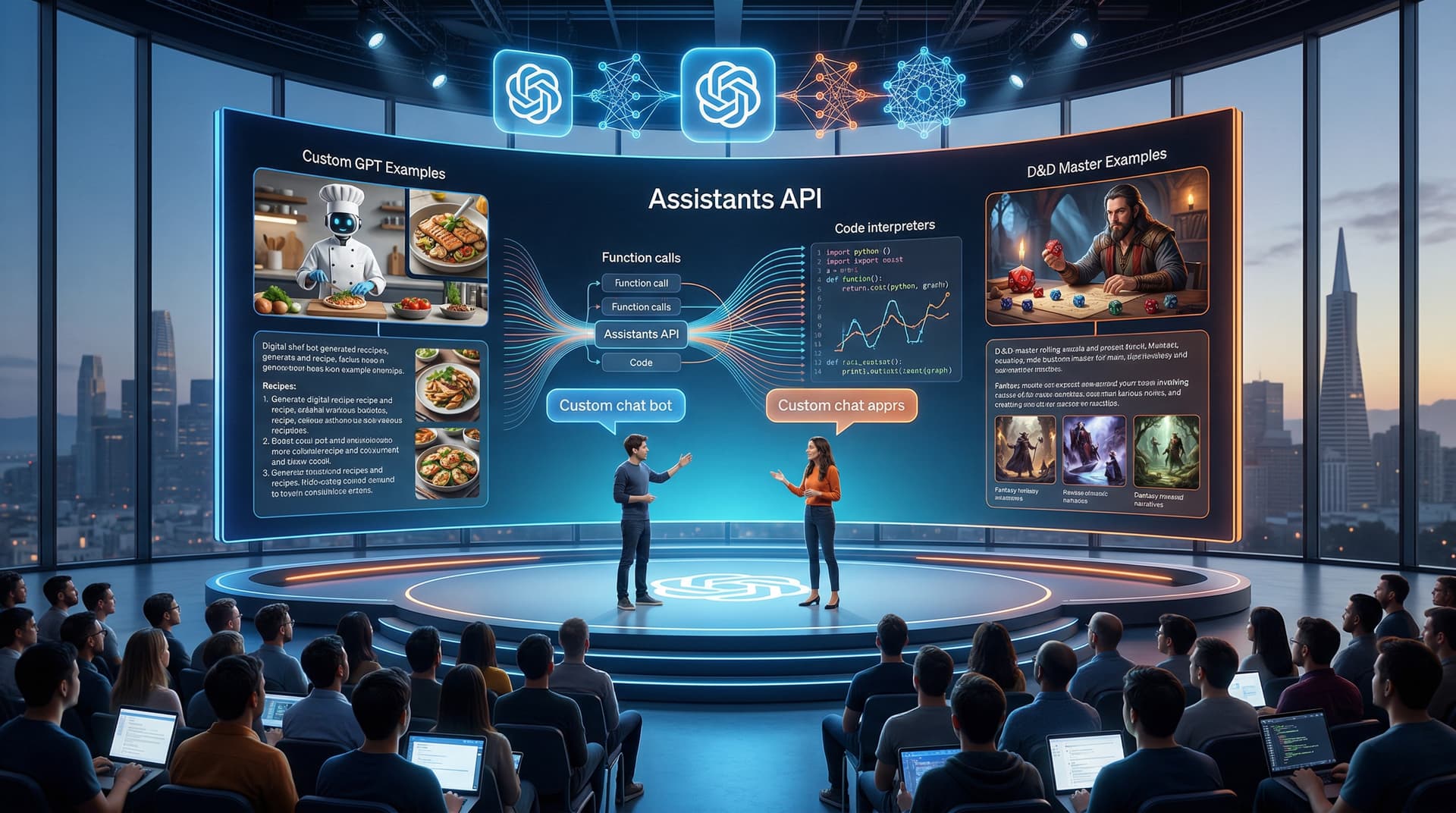
On November 6, 2023, OpenAI hosted its first-ever Developer Day (DevDay) in San Francisco, drawing hundreds of developers, entrepreneurs, and AI enthusiasts. The event was a showcase of the company's ambitious roadmap, focusing on tools that lower barriers to AI innovation. CEO Sam Altman and CTO Mira Murati took the stage to unveil features that transform ChatGPT from a general-purpose chatbot into a platform for personalized AI agents. This wasn't just hype; it was a concrete step toward making advanced AI accessible to non-experts while supercharging developers.
Custom GPTs: AI Tailored for Everyone
The star of the show was Custom GPTs, allowing users to create specialized versions of ChatGPT without coding. Imagine a GPT for recipe generation that remembers your dietary preferences, or one that analyzes legal documents with domain-specific knowledge. Users can upload instructions, extra knowledge files, and even enable capabilities like web browsing, DALL·E image generation, or code interpretation.
No programming required—just converse with ChatGPT to refine your creation. OpenAI demonstrated examples like a D&D Dungeon Master GPT that runs full campaigns, or a code reviewer that debugs pull requests. These GPTs are shareable via links, with a GPT Store preview announced for ChatGPT Plus users in the coming weeks. This store will let creators publish, discover, and even monetize their GPTs, echoing app stores like Apple's but for AI agents.
"We're giving everyone the power to create their own GPTs," Altman said, emphasizing the no-code ethos. Early access has already seen tens of thousands of GPTs built since the quiet rollout days before DevDay. For businesses, this means rapid prototyping of internal tools, from customer support bots to marketing analyzers.
Assistants API: The Backbone for Production AI
For developers seeking scalability, the Assistants API steals the spotlight. This new API enables building sophisticated AI assistants with persistent threads, long-term memory, and advanced tools. Key features include:
- Function Calling: Seamlessly integrate external APIs, like querying databases or third-party services.
- Code Interpreter: Run Python code in secure sandboxes for data analysis and visualization.
- File Search: Index and retrieve from uploaded files using embeddings.
- Vision Capabilities: Analyze images alongside text, powered by GPT-4 with vision.
Unlike the previous Chat Completions API, Assistants maintain state across conversations, making them ideal for complex workflows. OpenAI highlighted integrations with Retrieval-Augmented Generation (RAG), where assistants pull real-time data without retraining models.
Pricing is competitive: $1.50 per million input tokens and $4.50 per million output for gpt-3.5-turbo, with similar rates for GPT-4. Fine-tuning support now extends to gpt-3.5-turbo-instruct, allowing custom models at $0.008 per 1K tokens training and $0.0004–$0.0012 inference.
A live demo showed an assistant booking flights by calling APIs, processing payments, and confirming via email—all autonomously. Developers from companies like Replicate and Vercel praised its ease, noting deployment in minutes.
Broader Ecosystem and Integrations
OpenAI deepened ties with partners. Microsoft Azure will host Assistants API, leveraging its enterprise-grade infrastructure. New SDKs for Python and Node.js simplify adoption, with playgrounds for testing.
The event also teased multimodal advancements. GPT-4 Turbo now supports 128K context windows and vision, enabling richer interactions. Audio features like real-time speech-to-speech were previewed, hinting at more natural voice interfaces.
Implications for AI Developers and Startups
DevDay positions OpenAI as a platform company, akin to AWS for AI. Startups can now build vertical AI apps faster—think legal tech like Harvey.ai scaling with Assistants, or creative tools rivaling Midjourney.
However, challenges loom. Data privacy concerns arise with file uploads; OpenAI assures SOC 2 compliance and opt-out training. Compute costs remain a hurdle for high-volume apps, though optimizations like batch API (50% cheaper) help.
Competition heats up. Anthropic's Claude and Google's Gemini offer similar APIs, but OpenAI's first-mover advantage in consumer GPTs and ecosystem (40M+ weekly users) is formidable. Startups like LangChain and LlamaIndex will adapt, integrating Assistants for agentic workflows.
The Road Ahead
Altman closed by framing this as "GPTs for everyone, agents for developers." With the GPT Store launching soon, expect an explosion of niche AI tools. For machine learning pros, fine-tuning and long-context models accelerate research-to-production pipelines.
DevDay underscores AI's maturation: from black-box models to composable building blocks. As Murati noted, "The future of AI is collaborative." Developers left energized, notebooks filled with ideas. OpenAI's moves could democratize AI like smartphones did computing—watch this space as custom agents reshape industries.
(Word count: 912)