
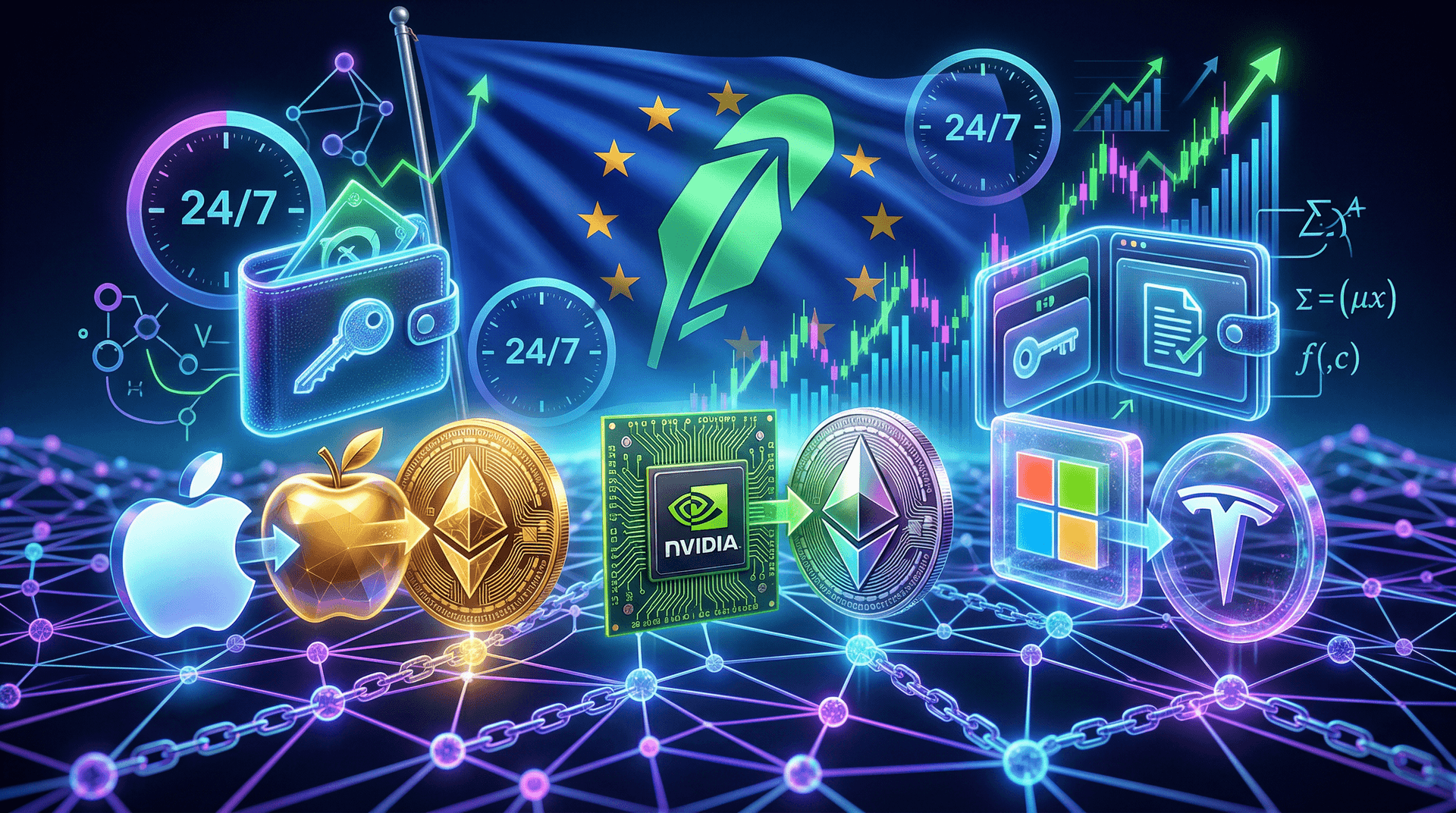
In a bold move blending traditional finance with blockchain technology, Robinhood announced on August 7, 2024, the launch of tokenized US stocks and ETFs for its European Union customers. Powered by the Arbitrum Layer 2 network, this initiative allows EU users to trade digital versions of over 200 popular American equities—including heavyweights like Apple, Microsoft, Nvidia, and Tesla—as well as ETFs, 24 hours a day, seven days a week.
The Details of the Launch
Robinhood's new offering is immediately available to eligible EU customers (excluding residents of France, Spain, Italy, Belgium, and several other nations due to regulatory variances). Users can access these tokenized assets directly through the Robinhood Crypto app or web platform. Each token represents fractional ownership of the underlying stock, backed 1:1 by the actual shares held in custody by Robinhood Europe UAB, a licensed broker-dealer.
Key features include:
- 24/7 Trading: No more waiting for NYSE or Nasdaq hours; trade anytime via blockchain settlement.
- Self-Custody Options: Users can withdraw tokens to their own Web3 wallets for full control.
- Low Fees: Competitive pricing with spreads starting as low as 0.1%.
- On-Chain Transparency: All transactions settle on Arbitrum, leveraging Ethereum's security with lower costs and faster speeds.
Arbitrum, developed by Offchain Labs, was chosen for its scalability—handling thousands of transactions per second—and Ethereum compatibility. This isn't Robinhood's first dance with crypto; the firm has offered spot trading of Bitcoin, Ethereum, and others since 2018, and recently announced a $200 million acquisition of Bitstamp to bolster its global crypto presence.
Why Tokenized Assets Matter in Blockchain
Tokenization of real-world assets (RWAs) is one of the hottest trends in blockchain, projected to unlock trillions in value by making illiquid assets tradable on-chain. Robinhood's entry validates this shift, following pioneers like BlackRock, whose BUIDL tokenized money market fund on Ethereum surpassed $250 million in assets under management earlier this year.
RWAs bridge TradFi and DeFi by enabling:
- Global Accessibility: Anyone with an internet connection and wallet can own fractions of high-value stocks.
- Programmability: Smart contracts allow automated dividends, lending, or composability with DeFi protocols.
- Efficiency: Instant settlement reduces counterparty risk and clearing times from days to seconds.
In Europe, where MiCA (Markets in Crypto-Assets) regulations took effect in June 2024, tokenized assets fit neatly into the framework for "asset-referenced tokens." Robinhood's move complies with local rules, positioning it ahead of competitors like eToro or Revolut, which have flirted with crypto but not full tokenization.
Robinhood's Strategic Pivot to Blockchain
Robinhood, valued at over $20 billion post-IPO in 2021, has evolved from a meme-stock darling to a crypto powerhouse. The firm's crypto revenue surged 700% in Q2 2024, driven by Bitcoin ETF hype and rising volumes. CEO Vlad Tenev has repeatedly touted blockchain as the future of finance, calling tokenization "the next big unlock."
This launch builds on prior efforts:
- 2023: Introduced crypto wallets for self-custody.
- 2024: Expanded to Solana perpetuals trading and EU crypto services.
- Bitstamp Deal: Set to close later this year, adding institutional-grade exchange tech.
By leveraging Arbitrum, Robinhood taps into a thriving ecosystem with over $20 billion in total value locked (TVL) as of August 2024. Arbitrum's Orbit chains and Stylus tech enable custom rollups, hinting at future expansions.
Regulatory Tailwinds and Challenges
The timing is impeccable amid a crypto-friendly regulatory thaw. The US SEC's approval of spot Bitcoin and Ethereum ETFs earlier this year poured billions into the space, boosting confidence. In Europe, MiCA provides clarity, unlike the US's fragmented state-level rules.
However, challenges loom:
- Custody Risks: While Robinhood holds shares off-chain, oracle dependencies for price feeds could introduce vulnerabilities.
- Liquidity: Initial volumes may be thin compared to native stock markets.
- Cybersecurity: Blockchain's immutability is a double-edged sword; hacks like the $600 million Ronin bridge exploit in 2022 underscore needs for robust audits.
Robinhood assures military-grade security, including Fireblocks custody and Chainlink oracles.
Implications for Startups and the Broader Ecosystem
This launch supercharges blockchain startups in the RWA space. Projects like Centrifuge, RealT, and Ondo Finance, which tokenize real estate and treasuries, now have a high-profile validator. Arbitrum's TVL could swell further, benefiting developers building DeFi apps atop it.
For startups, Robinhood's scale—over 25 million funded accounts—offers distribution muscle. Expect copycats: Kraken and Coinbase have hinted at similar products.
In AI-blockchain intersections, tokenized stocks could fuel AI-driven trading bots on-chain, analyzing sentiment via models like those from Fetch.ai or SingularityNET.
Looking Ahead: The Dawn of On-Chain Equities
Robinhood's tokenized stocks are more than a product; they're a manifesto for blockchain's mainstreaming. As barriers fall, we could see tokenized commodities, art, and even private equity. With Bitcoin hovering near $60,000 and Ethereum upgrades like Dencun slashing fees, the infrastructure is ripe.
Critics argue it's "crypto-washing" stocks, but execution trumps intent. If Robinhood nails liquidity and compliance, it could onboard millions to Web3 without them knowing.
As a senior tech journalist, I've covered crypto since the 2017 ICO boom. This feels like 2021's NFT frenzy but grounded in utility. Watch for volume metrics in Robinhood's next earnings— they could signal the RWA revolution's ignition.
Word count: 912