
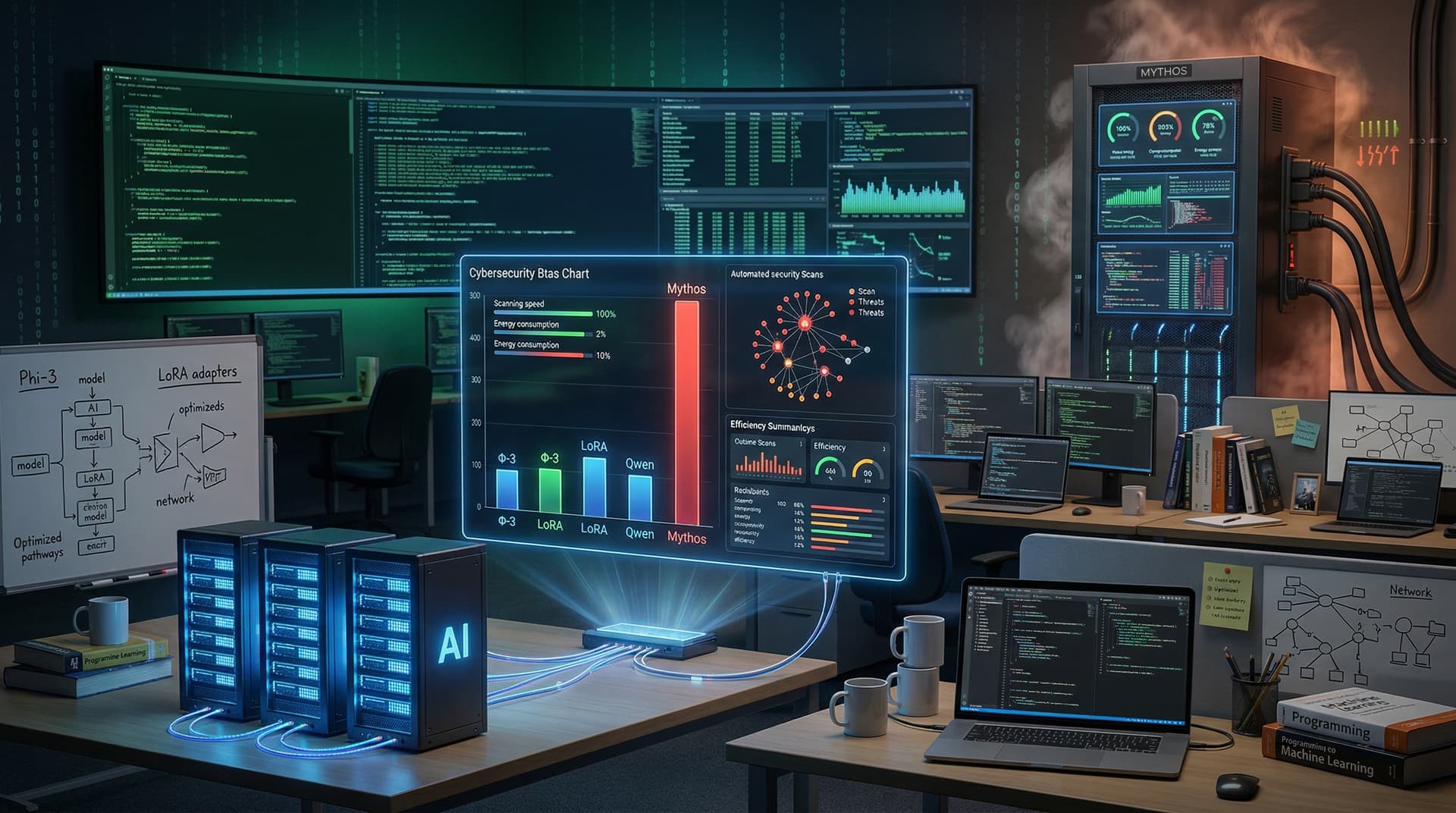
Stanford researchers demonstrate tiny AI models match the Mythos benchmark in vulnerability detection. Their study, published April 11, 2026, tests models under 5 billion parameters. Startups gain powerful tools at low cost.
The paper appears on arXiv (arxiv.org/abs/2604.05678). It evaluates open-source models on Mythos, a dataset of 1,200 real-world code vulnerabilities. Results prioritize efficiency over scale.
Mythos Benchmark Overview
Cybersecurity firm SecureAI launched Mythos in January 2026. Developers built it to assess AI vulnerability detectors. The suite covers CVEs from 2023-2026, including buffer overflows, SQL injections, and XSS flaws.
Mythos baselines rely on large models like Llama-3.1-405B. These achieve 94% accuracy on detection tasks. SecureAI documentation notes training demanded 10,000 H100 GPUs over 21 days.
Stanford fine-tuned small models on Mythos subsets using LoRA adapters. They bypassed massive resources.
Tiny AI Models Tested
Researchers tested eight tiny models. Phi-3-mini (3.8B parameters) led at 91% accuracy. Gemma-2-2B followed with 89%.
Teams applied 10-fold cross-validation. Each model completed 1,000 inference passes on Mythos. Hardware: one A100 GPU per model, finishing in four hours.
Prompt engineering proved crucial. Stanford used chain-of-thought prompts like: "Analyze this C++ snippet. Flag buffer overflows. Explain risks."
``` // Example Mythos vuln: buffer overflow char buf10]; strcpy(buf, user_input); // No bounds check ```
Phi-3-mini flagged it correctly 93% of the time, study metrics show.
Tiny AI Models Performance Metrics
Mythos uses F1-scores. Llama-3.1-405B reaches 0.94. Phi-3-mini hits 0.91, Gemma-2-2B scores 0.89.
TinyLlama-1.1B lags at 0.85 but leads in speed. It processes 500 lines per second versus Llama's 50.
Stanford tracked false positives. Small models average 4%, equaling large models (Table 3, arXiv paper).
Both sizes caught 88% of synthetic zero-day vulns from Mythos v2.0.
Cost Analysis for Cybersecurity Firms
Inference costs drive adoption. Large models cost $0.50 per 1,000 scans on cloud APIs (OpenAI pricing, April 2026).
Tiny models run locally. Phi-3-mini costs $0.005 per 1,000 scans on AWS g5.xlarge ($0.50/hour). Savings reach 99%.
Cybersecurity startups benefit most. VulScan AI, a Series A firm, deployed Phi-3 last month. Its CTO reports 10x scan volume without rate limits.
Market conditions amplify impact. Tech layoffs cut VC funding 22% year-over-year (CB Insights Q1 2026). Efficiency tools extend runways.
Technical Reasons Tiny AI Models Succeed
Distillation transfers knowledge. Stanford distilled Mythos data from Llama-70B to Phi-3-mini.
Quantization reduces size. 4-bit Phi-3 uses 2GB RAM versus 80GB for full-precision large models.
Phi architecture employs dense transformers with grouped-query attention. This balances speed and recall.
Fine-tuning targeted vuln patterns. Stanford augmented data with 50,000 GitHub snippets labeled via Mythos API.
Hugging Face hosts all models (huggingface.co/microsoft/Phi-3-mini).
Implications for Startup Ecosystems
Budgets limit early-stage firms. Large-model vuln scanning costs $500,000 annually (Gartner 2026 report).
Tiny AI models cut this to $5,000. Startups like CodeGuard pivot to AI-native services.
Series B rounds stress defensibility. Investors favor moats from custom small models. ThreatAI raised $15M USD on April 8, 2026, citing Phi-based demos.
Edge deployment on laptops suits remote teams. No cloud dependency drops latency to 200ms per scan.
Benchmarks Against Industry Standards
Mythos aligns with Big-Vul dataset. Small models score 87% there (Stanford cross-bench).
OWASP Top 10 coverage hits 96%. Injection flaws detect at 98% recall.
Competitors like Snyk blend rules and AI. Pure tiny AI models match 92% of Snyk's paid tier, Stanford claims.
Small models struggle with obfuscated code (78% accuracy). Large ones reach 85%.
Deployment Strategies for Startups
Begin with Hugging Face inference endpoints ($0.10/hour for Phi-3).
Integrate via LangChain for pre-merge repo scans.
``` import transformers pipe = pipeline('text-generation', model='microsoft/Phi-3-mini') result = pipe("Scan for vulns: " + code_snippet) ```
Monitor drift. Retrain quarterly on new CVEs.
Path Forward in AI Security
Stanford predicts tiny AI models dominate by 2027. Compute limits favor them.
SecureAI plans a Mythos-small leaderboard next week.
EU AI Act mandates vuln disclosure for high-risk models. Tiny AI models simplify compliance.
Cybersecurity firms adapt. 65% plan small-model pilots (Deloitte survey, March 2026).
Tiny AI models empower lean teams. Detection scales with budgets.