
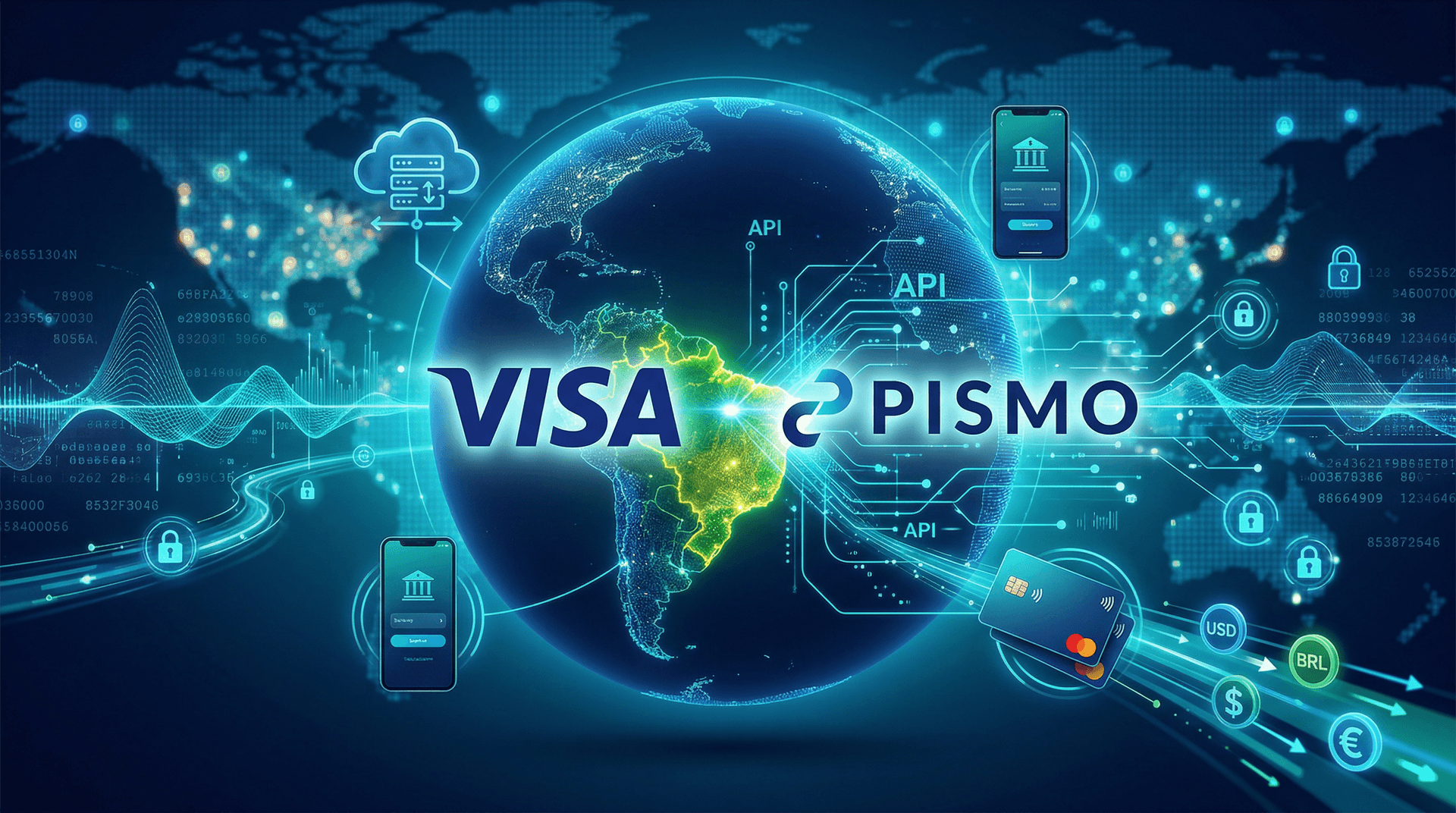
In a bold move to fortify its position in the rapidly evolving digital banking landscape, Visa Inc. announced on April 17, 2024, that it has agreed to acquire Pismo, a São Paulo-based cloud-native core banking platform, for approximately $1 billion. This acquisition underscores Visa's aggressive push into backend banking infrastructure, where modern fintechs are redefining how financial institutions deliver services through scalable, API-first platforms.
The Rise of Pismo: A Fintech Powerhouse from Brazil
Founded in 2016 by Radha Subramanian, Daniela Costa, and Marcio Loures, Pismo quickly emerged as a standout in Latin America's fintech ecosystem. The company provides a fully cloud-native core banking and processing platform that enables banks, fintechs, and payment companies to launch digital financial products at speed. Unlike legacy systems burdened by monolithic architectures, Pismo's modular design allows for seamless integration of cards, accounts, payments, savings, loans, and credit— all powered by robust APIs.
Pismo's growth has been meteoric. By early 2024, it served over 100 financial institutions across 11 countries, including heavyweights like Itaú Unibanco, Santander, and BV in Brazil, as well as BBVA in Spain and Emirates NBD in the UAE. The platform processes billions in transactions annually, demonstrating its scalability. Investors such as Tencent, Flourish Ventures, and Movile poured in over $200 million in funding rounds, with its last major raise in 2021 valuing it at around $400 million post-money.
What sets Pismo apart is its focus on composability. In an era where customers demand instant, personalized banking experiences, Pismo's microservices architecture lets clients mix and match features without vendor lock-in. This resonates in emerging markets like Brazil, where open banking regulations (Pix system) have spurred innovation, and in mature ones seeking modernization.
Visa's Strategic Play in a Fragmented Market
Visa, long dominant in payment networks, has been diversifying beyond transaction facilitation. Under CEO Ryan McInerney, the company is building verticals—end-to-end solutions for specific industries. Pismo fits perfectly into Visa Direct (real-time payments) and Visa's account issuer solutions, enabling deeper partnerships with banks worldwide.
"Pismo's technology platform will accelerate Visa's ability to deliver innovative, scalable banking solutions to our clients globally," said Visa's executive in the announcement. The deal comes at a time when fintech valuations have stabilized post-2022 downturn, making acquisitions attractive for incumbents like Visa to leapfrog development timelines.
Competitors abound: Thought Machine, Mambu, and Temenos offer similar core banking SaaS, while in Latin America, firms like Dock and FitBank vie for share. Visa's $1 billion price tag—roughly 2.5x Pismo's prior valuation—reflects premium for its tech stack and client roster, especially in high-growth Brazil (fintech hub with 1,000+ startups).
Implications for Fintech Startups and Investors
This acquisition signals consolidation wave 2.0 in fintech. After 2021's M&A frenzy (e.g., Nuvei by Advent for $6.3B), cash-rich payment giants are snapping up infrastructure plays. For startups, it validates the core banking model: 2023 saw Mambu raise $266M at $5.5B valuation, and Thought Machine secure major bank deals.
AI and cybersecurity angles: Pismo integrates AI for fraud detection and customer insights, aligning with Visa's $2.5B+ annual tech spend (including AI initiatives). Its cloud-native design inherently bolsters cybersecurity via zero-trust principles, crucial as breaches like Change Healthcare's expose vulnerabilities in legacy systems.
However, challenges loom. Integrating Pismo while maintaining independence (as Visa plans) risks cultural clashes. Regulatory scrutiny in Brazil's competitive market could delay closing, expected later in 2024.
Broader Fintech Landscape in April 2024
Pismo's sale caps a vibrant April for fintech. Stripe mulled a $65B tender offer, Coinbase expanded internationally, and Bitcoin ETFs saw record inflows amid halving hype. Yet, startups face headwinds: Synapse's shutdown disrupted neo-banks, highlighting API reliability risks.
For Visa, this bolsters its $30B+ revenue moat. With 4.4B cards issued, embedding Pismo's tech could capture more of the $100T+ global payments flow.
Expert Reactions and Future Outlook
Analysts applaud the move. Forrester's Dipanjan Chatterjee noted, "Visa is betting on APIs as the new battleground." Pismo CEO Subramanian added, "Joining Visa unlocks global scale for our platform."
Looking ahead, expect more such deals. Fintech funding hit $10B in Q1 2024 (CB Insights), but profitability trumps growth. Startups like Column (US core banking) or Railsr (UK processing) may follow Pismo's path.
In summary, Visa's Pismo acquisition isn't just a $1B check—it's a blueprint for how payments incumbents conquer digital banking's future. As open banking proliferates (EU's 2024 mandates, Brazil's Pix evolution), platforms like Pismo will be the rails powering it all.
Word count: 912