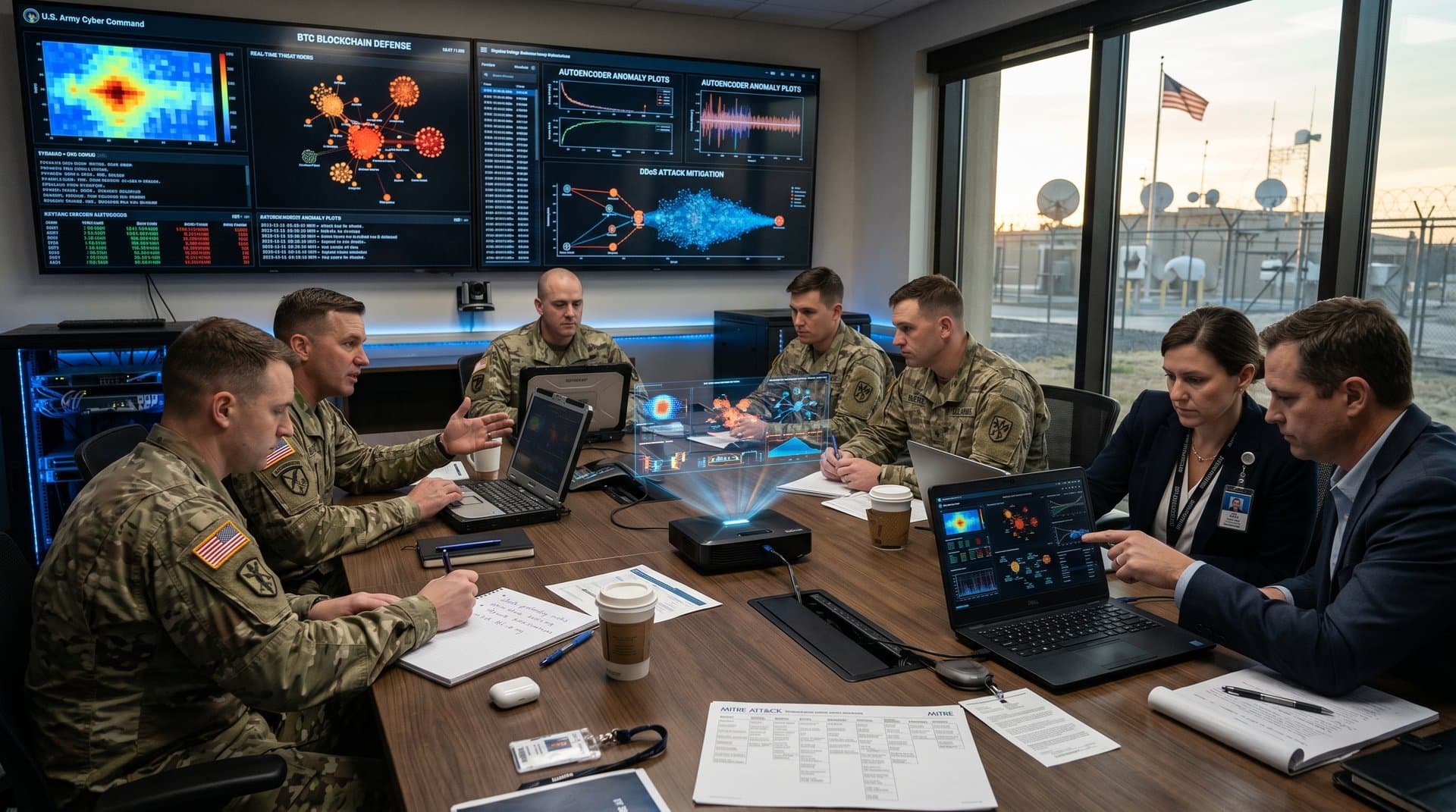

- AI speeds MDMP mission analysis by 50%, per Small Wars Journal.
- 3 paths emerge: adversarial defense, secure training, quantum-safe crypto.
- DoD Replicator funds $1B+ for cyber-secured AI prototypes.
Small Wars Journal authors report AI integration in military analytics accelerates MDMP mission analysis by 50% Small Wars Journal. Intelligence teams process satellite and sensor data faster. This creates cybersecurity startup opportunities targeting $1B+ DoD contracts.
The Military Decision-Making Process (MDMP) includes seven steps. Commanders receive the mission first. Mission analysis follows as step two. Analysts synthesize terrain data, enemy forces, and civilian factors into a shared understanding. DoD doctrine stresses speed. AI processes vast datasets from multiple sources.
Small Wars Journal authors note AI reduces cognitive load on analysts. Supervised machine learning classifies threats in imagery. Natural language processing (NLP) extracts insights from intelligence reports. Palantir platforms power U.S. Army workflows and cut analysis time by 40%, per Army evaluations.
How AI Enhances MDMP Mission Analysis
AI automates intelligence preparation of the battlefield (IPB). Transformer models replace manual geospatial overlays. Computer vision detects anomalies in drone footage at 95% accuracy, per DARPA benchmarks DARPA AI Forward.
Federated learning trains models across forward bases. Devices update weights without transmitting raw data. DARPA's AI Forward program confirms these methods enhance operational security.
Reinforcement learning simulates enemy maneuvers. Large language models (LLMs) query cultural factors for commanders. Outputs feed into Joint All-Domain Command and Control (JADC2). DoD mandates human validation per Joint Publication 3-0.
AI falters on rare black swan events. Models trained on historical data overlook novel tactics. Human intuition addresses these gaps.
Cybersecurity Risks in Military AI Integration
Adversarial attacks alter inputs to fool models. China-linked actors hit U.S. systems in 2023 SolarWinds-style breaches. Data poisoning corrupts training datasets at collection.
Model inversion reconstructs sensitive intelligence from outputs. Supply chain flaws affect libraries like PyTorch. CISA lists 200+ CVEs in AI frameworks CISA AI Roadmap.
Quantum threats use Shor's algorithm to crack RSA keys. Edge devices face interception risks during inference. Zero-trust redesigns raise deployment costs 20-30%.
Insider threats enable model theft via cloud APIs. DoD breach costs hit $4.5B annually, per 2023 GAO report.
3 Cybersecurity Startup Paths from AI Integration in Military Analytics
Startups pursue three high-value paths. First, adversarial defense applies certified defenses and randomized smoothing. Firms like Protect AI secure classifiers and raised $35M in Series A.
Second, secure training uses differential privacy. Noise addition limits data leakage. Google developed this; DoD startups achieve 10x efficiency gains while complying with standards.
Third, quantum-safe cryptography deploys NIST-standard Kyber and Dilithium lattices. Anduril integrates them into drones and secured $100M contracts.
Homomorphic encryption computes on encrypted data. Secure multi-party computation (SMPC) enables shared insights without exposure. Scale AI safeguards labeling pipelines at $1B valuation.
DoD Funding Accelerates Cybersecurity Startups
Defense Innovation Unit (DIU) fast-tracks dual-use prototypes. SBIR Phase III grants total $150M per project. Pilots yield $50M production contracts over three years.
Andreessen Horowitz deploys $500M into American Dynamism. Anduril reaches $8.5B valuation via cyber-AI integration. AWS GovCloud cuts dual-use compliance costs 25%.
DoD Replicator initiative funds $1B for 1,000+ autonomous systems with cyber defenses. GAO audits show 30% AI resilience budget growth.
Investor Gains from Military AI Cybersecurity
Adversarial defenses slash breach costs 60%, saving $2.7B yearly at scale. Secure training lifts model accuracy 15% under CISA rules.
Quantum-safe crypto protects $500B DoD IT budgets. AUKUS unlocks $100B markets for U.S. startups. NATO adopts JADC2-compatible stacks.
MIT and Stanford talent demands $500K salaries. Austin and Boston hubs shorten cycles to weeks near ranges.
AI integration in military analytics ensures U.S. superiority. Cybersecurity startups capture first-mover advantages and 5x investor returns.
Frequently Asked Questions
What is AI integration in military analytics?
AI integration in military analytics automates MDMP mission analysis. It processes IPB and predictive models. Small Wars Journal outlines enhancements.
How does AI improve MDMP?
AI accelerates mission analysis in MDMP's 7 steps. Machine learning detects threats faster. DoD requires human oversight.
What cybersecurity risks arise from military AI?
Data poisoning and adversarial attacks threaten models. CISA flags supply chain issues. Zero-trust architectures mitigate risks.
What opportunities await cybersecurity startups in military AI?
Startups offer homomorphic encryption and certified defenses. DIU contracts and SBIR grants drive $100M+ deals.