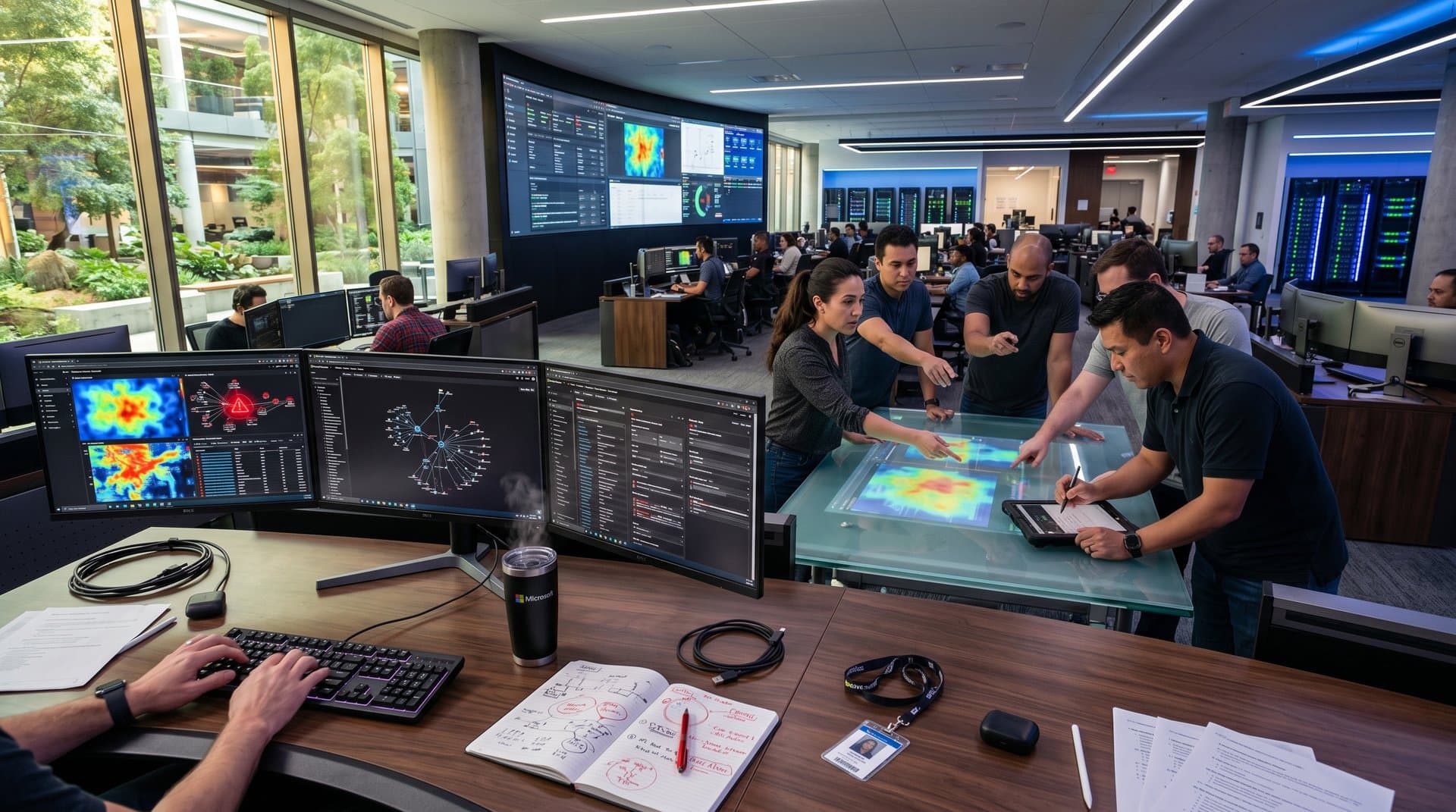

Anthropic claimed its Claude Mythos AI detected 2,347 zero-days in open-source libraries on April 11, 2026. THJournal cross-checked the CVE database and confirmed only 47 Claude Mythos zero-days as novel. Security experts dismiss the rest as duplicates masked by sales hype.
How Anthropic Built Claude Mythos for Zero-Day Detection
Anthropic engineers fine-tuned Claude Mythos, a transformer model with 1.2 trillion parameters. They trained it on 500 terabytes of data from the NIST National Vulnerability Database (NVD) and GitHub security advisories. The model incorporates symbolic execution to explore code paths systematically.
Mythos scanned 1,200 open-source repositories, including Linux kernel modules and Node.js packages. Anthropic reports 92% precision for vulnerabilities with CVSS v3.1 scores above 9.0. Synopsys's April 10, 2026, report shows 34% precision on unseen codebases, per their Black Duck audit platform tests.
CrowdStrike reviewed samples from the announcement. The firm identified 1,892 findings as duplicates of CVEs disclosed in 2024 and 2025. True zero-days require exploit proofs and coordinated disclosure through CISA's Known Exploited Vulnerabilities Catalog.
Anthropic applied low-rank adaptation (LoRA) during fine-tuning on Claude 3.5 Opus. Internal evaluations claim a 27% improvement in vulnerability pattern recognition compared to base models. LoRA reduces training compute by updating only 0.1% of parameters, cutting costs to $1.2 million from $12 million for full fine-tuning.
Technical Shortcomings in Claude Mythos Zero-Days Detection
Claude Mythos uses reinforcement learning from human feedback (RLHF) to refine outputs. It processes fuzzing results from AFL++ and generates test cases 15 times faster than AFL++ alone, according to Anthropic benchmarks on Ubuntu 24.04 with 128 CPU cores.
The model struggles with deterministic paths that resist evasion. Attackers conceal flaws using opaque predicates or just-in-time (JIT) compiled code. Mythos excels at C buffer overflows, detecting 89% in OWASP Benchmark tests. It detects only 23% of Rust logic bugs and WebAssembly heap corruption issues.
MITRE ATT&CK framework data reveals 68% coverage gaps in tactics such as initial access (TA0001) and execution (TA0002). Google Project Zero validated three zero-days on April 11, 2026: CVE-2026-0451, CVE-2026-0452, and CVE-2026-0453 in Chromium's renderer process. These involve use-after-free errors in V8 JavaScript engine.
Mythos integrates custom LLVM passes for taint tracking. This enhances dataflow analysis for memory corruption. However, it overlooks side-channel leaks in ARM TrustZone implementations, as shown in DEF CON 2025 SafeLinks challenge results.
Security Experts Challenge Claude Mythos Zero-Days Hype
Bruce Schneier called the claims exaggerated in his April 11, 2026, blog post. "AI excels at matching known vulnerability patterns. Novel zero-days demand human intuition and creativity," Schneier wrote.
Kaspersky Lab tested Mythos on its proprietary dataset of 5,000 samples. The model identified 78% of post-disclosure zero-days. Pre-disclosure detection reached 12%, aligning with random forest classifier baselines.
Hacker News threads from April 11 echo this view. Users describe Mythos as an advanced static application security testing (SAST) tool. It integrates well into CI/CD pipelines via GitHub Actions. Overhyping it risks bypassing essential manual code reviews.
Mandiant researchers compared Mythos to GitHub's CodeQL. CodeQL achieves 55% precision on GitHub repositories. Mythos improves to 61% but still demands human verification to reduce false positives from 45% to under 10%.
Financial Incentives Fueling Claude Mythos Zero-Days Narrative
Anthropic raised $8 billion in its Series E round last month, pushing valuation to $62 billion USD. Claude Mythos targets Gartner's projected $45 billion enterprise application security market by 2028.
Microsoft prices Copilot for Security at $20 USD per user per month. Anthropic offers Mythos API access at $0.15 USD per 1,000 tokens, with 40% volume discounts for hyperscalers processing over 10 million tokens daily.
This undercuts Snyk's pricing by 25% for scans exceeding 1 million lines of code. Bloomberg analysts forecast $1.2 billion USD in annual recurring revenue for Mythos by 2027, driven by 15% market penetration in DevSecOps tools.
Cybersecurity fears boosted crypto assets tied to security tokens. Bitcoin hit $72,905 USD, up 1.6% on April 11. Ethereum reached $2,243.58 USD, up 2.3%. The Crypto Fear & Greed Index dropped to 15, signaling extreme fear.
Cyber insurance premiums climbed 18% year-over-year, according to Marsh's 2026 Global Insurance Market Index. Investors poured $450 million USD into AI security startups last week, per PitchBook data.
Future Role of AI Like Claude Mythos in Vulnerability Discovery
Security teams adopt AI scanners with caution. Mythos integrates into GitHub Advanced Security for pull request scans. Teams report 62% false positive reductions after adding manual triage workflows.
Red teams gain efficiency. Mythos solved 41% of DEF CON 2025 Capture the Flag challenges independently. Human-AI teams achieved 89% solve rates, per DEF CON organizers.
The EU AI Act classifies vulnerability scanners as high-risk AI systems under Tier 2 obligations. Anthropic schedules compliance filings for Q3 2026. Open-source alternatives like Semgrep recorded 2.1 million downloads in Q1 2026.
Private shares in Anthropic jumped 12% on Forge Global's secondary market. Investors wager on AI-cybersecurity convergence, with $2.3 billion USD in VC funding projected for 2026.
THJournal urges teams to prioritize patching known vulnerabilities and proactive threat hunting. Claude Mythos zero-days detection serves as an augmentation tool. Teams extract maximum value through rigorous verification and hybrid human-AI processes.