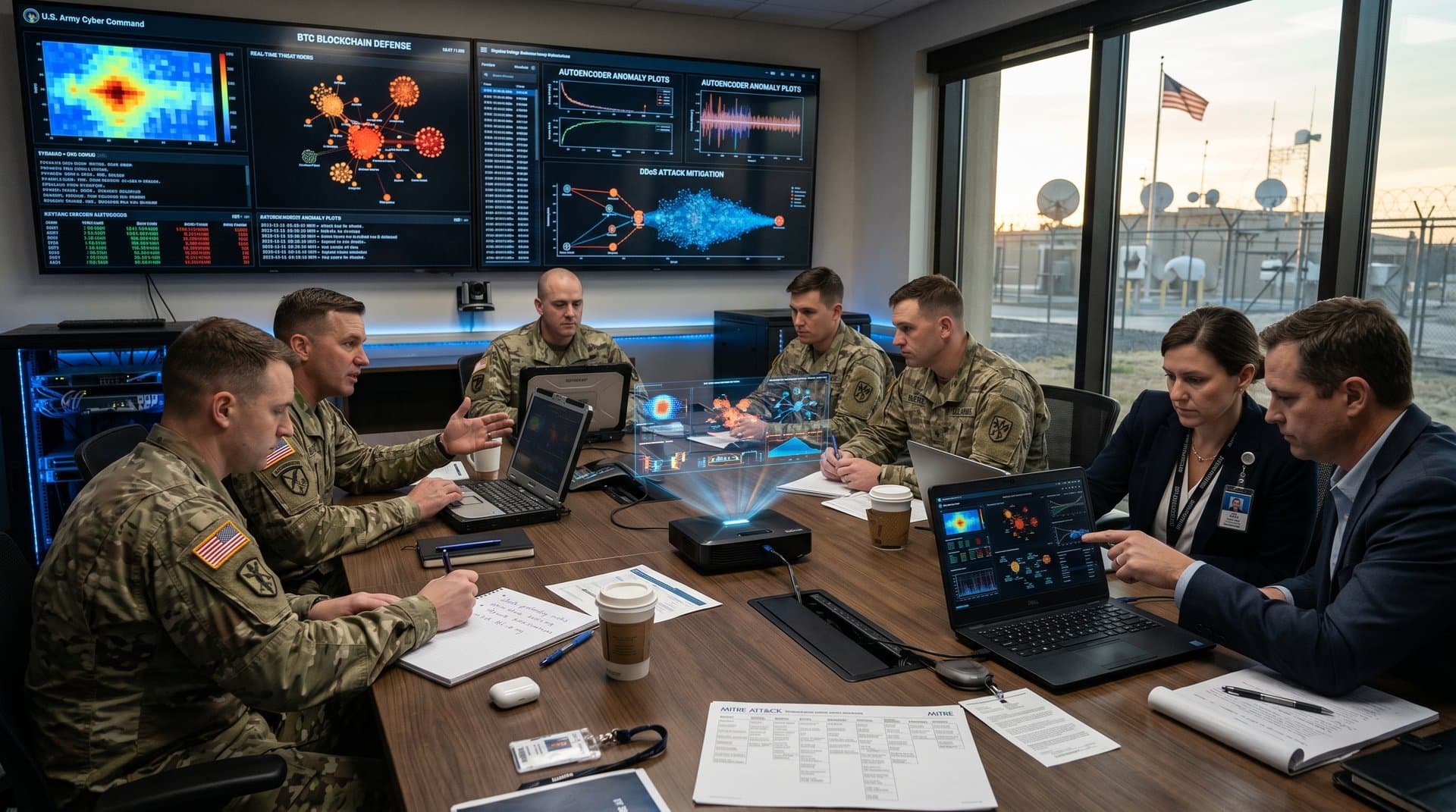

DARPA launched its $50 million USD AI agent comms program on April 10, 2026. The initiative standardizes secure communications for multi-agent cybersecurity systems. Startups gain open tools to bolster defenses against swarm vulnerabilities.
The U.S. Defense Advanced Research Projects Agency detailed the program in its official release. Computerworld reported the launch. AI agents now detect network anomalies. Swarms enable real-time threat responses. Insecure communications expose these systems to attacks.
DARPA AI Agent Comms Objectives and Funding
DARPA chose four teams led by universities and firms like Palo Alto Networks. Each team receives up to $12.5 million USD over three years. Teams build open standards for agent-to-agent messaging.
Engineers extend TLS 1.3 with agent-specific features, including zero-knowledge proofs via Schnorr protocols for authentication. DARPA specs demand sub-10ms latency in attack simulations.
Startups spend over $5 million USD on custom AI fleet security R&D. DARPA provides GitHub reference implementations by 2028. Early adopters achieve 30% faster deployments, per DARPA's preliminary whitepaper.
Cybersecurity Implications
Multi-agent AI systems outperform single models in detecting zero-day exploits. Agents share threat intelligence across network edges. Attackers exploit inter-agent channels to spread malware.
New protocols employ homomorphic encryption, allowing computations on encrypted data without decryption. An MIT CSAIL report from April 2026 details a prototype that blocks 95% of simulated man-in-the-middle attacks.
Startup SentinelAI adopted similar technology and raised $20 million USD in March 2026. Investors highlight secure comms as a key edge.
```javascript // Simplified secure agent handshake async function initiateSecureChannel(peerId) { const key = await generateEphemeralKey(); const proof = await zkProve(identity, key); // Schnorr ZKP const encryptedProof = encrypt(proof, key); await send(encryptedProof); if (await peer.verify(proof)) { return await establishChannel(); } throw new Error('Handshake failed'); } ```
Production code incorporates quantum-resistant Dilithium signatures.
Startup Ecosystem Benefits
Cybersecurity startups raised $2.1 billion USD in Q1 2026, per PitchBook. AI-focused firms claimed 40%. Secure AI agent comms lower barriers for Series A rounds.
Venture firms like Andreessen Horowitz invest in agent defenses. They forecast a $10 billion USD market by 2030. DARPA's open-source efforts spur growth.
San Francisco startup CyberSwarm tests DARPA prototypes. CEO Maria Lopez reports leak-free coordination across 1,000 nodes. Revenue doubled since January 2026.
Secure comms aid fintech startups in transaction monitoring. Banks license the tech, yielding $500K+ USD per client annually.
Technical Challenges
Teams address scalability for thousands of agents on standard networks. DARPA requires gossip protocols for propagation.
Benchmarks evaluate adversarial resilience. NIST's April 2026 report reveals 20% failure rates in current systems against data poisoning. Solutions use federated learning.
Protocols ensure interoperability with LangChain and AutoGen. DARPA baselines JSON-RPC over WebSockets.
Competitive Developments
OpenAI's agent toolkit v2.0 from March 2026 offers basic secure RPC without defense-grade encryption.
Google DeepMind collaborates with NSA on internal tech. DARPA's public standards attract startups.
European firms prepare for EU AI Act. DARPA protocols provide verifiable compliance.
Path to Deployment
Prototypes launch in Q4 2026. Field tests run at military bases. Startups access sandboxes via DARPA portal.
Success metrics track CVE reductions. Early trials cut incidents by 25%, per DARPA logs cited by Computerworld.
Cybersecurity IPOs rose 15% in 2026. AI agent tech drives leadership. DARPA AI agent comms positions U.S. startups globally.